Unpacking Advanced Air Mobility
A Conversation With Greg Campbell and Scott Denny
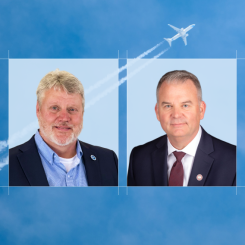
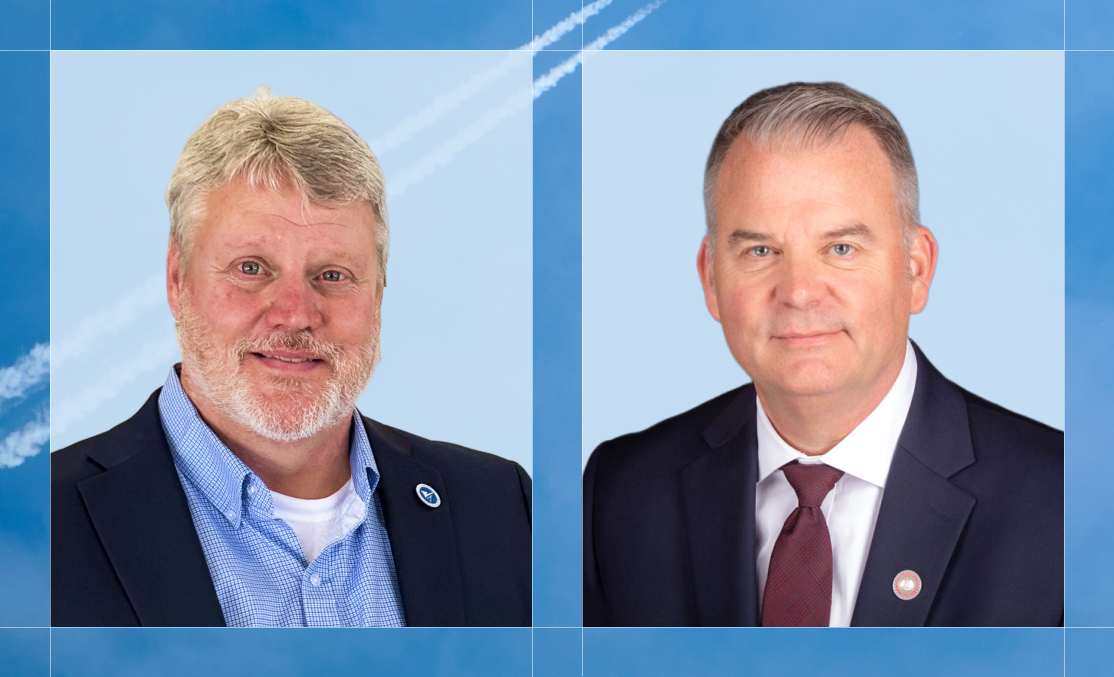
Greg Campbell is director of the Virginia Department of Aviation (DOAV), the agency charged with advancing aviation across Virginia. Scott Denny is the agency’s first senior program manager for advanced air mobility (AAM). VEDP Managing Director of Aerospace and Defense Innovation Graham Griffith, a U.S. Air Force reservist and MQ-9 pilot, spoke with Campbell and Denny about Virginia’s role in AAM and what the Commonwealth is doing to prepare for the next wave of aviation innovation.
Graham Griffith: Greg, can you give us a brief overview of the Virginia Department of Aviation and its responsibilities in the Commonwealth?
Greg Campbell: We’re part of the Transportation Secretariat, charged with developing, promoting, and advancing aviation in Virginia. That involves a variety of things, including supporting airports through assistance in grant programs and other planning and engineering support the airports may need, helping them with their economic growth and the Commonwealth’s economic growth related to aviation. Also, aviation education and workforce — trying to foster and create a healthy Virginia aviation ecosystem.
Griffith: Diving a bit deeper into the advanced air mobility portfolio, Scott, you’re the first AAM director at DOAV. Can you explain the concept and its practical implications?
Scott Denny: Advanced air mobility is a term for new technologies that have come on board with aviation. Recently, a lot of hype has been in the news regarding electric aircraft, electric vertical takeoff and landing (eVTOL) aircraft, and ultra-short takeoff and landing aircraft, both the people movers and the drones. We’re integrating these new technologies into the national airspace system.
Virginia has been on top of providing the infrastructure needed at the existing airport systems. The AAM OEM manufacturers have indicated to us that they want to operate out of Virginia’s existing airport system. A majority of the infrastructure that they’re looking for is already in place, and that makes Virginia very attractive to them.
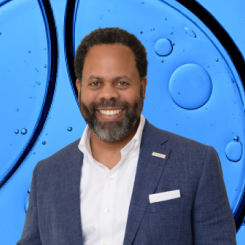
Scott Denny
Senior Program Manager for Advanced Air Mobility, Virginia Department of Aviation
Griffith: Can you talk specifically about the role DOAV plays in Virginia’s AAM space?
Denny: The Department of Aviation’s primary role involves infrastructure. Take drones as an example. We work with localities in which new technologies and drones will operate to educate them on what’s necessary. That involves things like updating local zoning ordinances to allow takeoff and landing within their jurisdictions, or providing sufficient electrical power to their community airports to support these aircraft.
Griffith: Can you pull the thread on that a bit? As someone who used to fly unmanned systems in the Air Force, it’s near and dear to my heart. Where are the gaps as new technology is injected into existing infrastructure? What are ways DOAV has taken a leading role in ensuring that we lay the groundwork in Virginia for AAM?
Denny: If you think about aviation history in general, it started in 1903 with the Wright Brothers. Since then, jurisdictions have constructed airports. Initially, they were fields in the middle of nowhere, far beyond residential or commercial development. Over the years, airports addressed aviation available at the time. It started with biplanes, then traditional single-engine aircraft, then multiple-engine aircraft. And as communities grew, airports in the middle of nowhere were suddenly surrounded by population and businesses. But airports themselves have always dealt with traditional aircraft platforms — single-engine Cessnas, for example, which typically require a 2,000–5,000-foot runway. They’ll take off, fly from point A to point B, return to the airport, land on the same runway, and park in a traditional hangar.
New technologies, especially drones, can take off anywhere, they don’t even need an airport. A simple field will suffice. Electrical takeoff and landing aircraft have entirely different performance criteria. Whereas a traditional aircraft requires the 2,000-foot landing and takeoff area, some eVTOLs can land on what the FAA has identified as a vertiport or heliport, which is typically only 50 by 50 feet. It’s a completely different platform. We’re trying to make sure the Commonwealth’s airports have the new infrastructure, like for example three-phase power, which is necessary to support future technologies.
Campbell: Part of our outreach and collaboration around AAM has been to engage with original equipment manufacturers (OEM) and the companies and service providers that plan to put these vehicles into service. We listen and try to meet them where they are in development and make sure we’re ready when they’re ready to deploy these new aircraft. We’ve gotten a lot of good feedback from them. Scott touched on the smaller unmanned systems. When you move to larger AAM aircraft, the eVTOLs and ultra-shorts, the OEMs and companies planning to utilize these, at least in the short- and mid-term, bank heavily on existing infrastructure. A lot of our focus has been on existing airports and heliports, making sure the fundamentals are there to support these operations.
Scott mentioned three-phase power. An example would be that we created a grant program to get all 65 public-use airports up to the necessary three-phase power standard. Also, we had a program to stand up broadband to ensure good connectivity in all the airports. That’s another feature they told us they’ll need to power some navigation and communication systems. They’re using a lot of existing infrastructure, but improvements were still needed to move forward. And we do know that, in addition to existing infrastructure, we may need some new facilities. Scott mentioned vertiports. In some areas we still don’t have coverage to align with that.
We think that comes a bit later, but we’re certainly looking at it now to determine existing gaps. We’re lucky that Virginia has done a good job with system planning over the last 40 or 50 years. Currently, I think 93–94% of our population lives within 30 minutes of an airport. You add in heliports, and Virginia has really good coverage. We’re well positioned to host a lot of new services and activities with the new aircraft.
Griffith: What are some non-Virginia Department of Aviation resources here that you’ve used to build your knowledge and research base for your policy and infrastructure work with AAM?
Campbell: We have some great assets in Virginia. For example, Virginia Tech and the Mid-Atlantic Aviation Partnership (MAAP) in Blacksburg is one of only a half a dozen FAA-approved test sites for unmanned aerial systems and AAM in the country. We’ve partnered extensively with MAAP. They’ve done a variety of projects to help in planning and preparation — things like conducting a minimum viable infrastructure report for us. That was our roadmap for our AAM strategy and determining what minimum viable infrastructure looks like. NASA Langley is another resource we’re fortunate to have.
Denny: Having OEMs themselves, manufacturers like Electra, to sit down and give us a baseline of what they need to flourish here in the future has been a great asset. That and the Advanced Air Mobility Multi-State Collaborative through the National Association of State Aviation Officials, which is a conglomeration of aeronautics divisions throughout the 50 states. We get to talk to these states and find out what’s new in their localities and how they respond to changes in FAA regulations so we can attempt to harmonize policy throughout the country. That’s been an invaluable resource.
Griffith: One of Virginia’s unique competitive edges is our geography. Something I think about often is that we’re on the coast and have access to the Wallops Flight Facility. And we’ve got access to the range and restricted airspace and testing areas off the Eastern Shore. Scott, can you talk about coastal air mobility, using waterways instead of airports and runways? Is the Virginia Department of Aviation playing a role?
Denny: Coastal air mobility is a great upcoming field. We’re talking about amphibious aircraft that solely lands on water, or can transition between both water and traditional airfields. At the Department of Aviation, we have always licensed water runways in the Commonwealth. It’s a unique field where a lake or waterway that can accommodate an aircraft can be used as well. The department would license it similarly to a public-use runway, where we’d go out and inspect the site. It opens up an entire portion of the Commonwealth that wouldn’t normally be accessible. Some new technologies involve cargo movement. I spoke to an entity this week that’s interested in doing that here. It opens up an entire new possibility and range.
Virginia sees [general aviation facilities] as the front door to the community. They need to be designed to handle what’s coming. And we’re in a really good position here in Virginia, and a lot of our airports are really leaning into it.
Greg Campbell
Director, Virginia Department of Aviation
Griffith: Greg, as a former director of the Shenandoah Valley Regional Airport, could you comment on how Virginia’s airports can continue to lay the groundwork for the future of aviation?
Campbell: Airports are the focal point of aviation in their community. We’ve been working with them to provide education on what some of these new technologies look like and what minimum infrastructure requirements they must meet to accommodate them. There’s a lot of excitement. Of those 65 public-use airports, quite a few may not have realized the benefits of commercial aviation services because of runway lengths or other issues that may now be overcome by AAM.
Along the same lines, we’re working on one project with Virginia Tech and MAAP that we think is cutting-edge. These AAM aircraft will have unique profiles and new flight procedures as they approach airports. Our Virginia Tech project is called Smart Airspace. Several of the larger OEMs are helping us with test flying and validating those routes. That’s key to unlocking a lot of smaller facilities, making sure access is possible by these new aircraft and during all weather conditions so that it’s predictable and reliable.
That’s a project we’re really excited about and seeing a lot of progress on. It’s going to open up parts of Virginia to aviation that have been closed off. We’re excited about opportunities for some of our rural regions, in particular.
Griffith: Scott, you mentioned the Multi-State Collaborative. Greg, can you talk about how Virginia’s taken a thought leadership role nationally on AAM policy and standardization through the collaborative?
Campbell: About two and a half years ago, we hosted the collaborative’s first meeting. There were only six or seven state members. As Scott said, two things we focus on at the Department of Aviation are our primary roles in AAM infrastructure and policy. Our focus is on how we harmonize policy across the board to make it industry-friendly — that it’s safe and protects the public. Also, how do we do that so it doesn’t hamper this industry’s development and rollout? We’re making good progress. The more states that join us, the more ideas and info we get.
The collaborative has also become a primary source for the Federal Aviation Administration (FAA) when they want to work with states. As state aviation bureaus, we sit between federal regulators and the local level where all this aviation takes place. The FAA has recognized the Multi-State Collaborative as a primary partner in helping them develop national AAM strategy and the regulatory environment. As states, we collaborate as much as possible because these aircraft will fly across state borders. The more we can harmonize infrastructure and the regulatory environment and policies, the more successful it will be.
Federally, within the last year, the FAA and Department of Transportation issued an RFP for state and local governments to present projects for demonstrating AAM integration under a new eVTOL Integration Pilot Program. They were initially going to choose five, but ended up choosing eight projects. Our Multi-State Collaborative was one of those. And the very first integration pilot program flights in the country under that program happened here in Virginia with BETA, which makes an electric conventional takeoff and landing, but it’ll eventually be an eVTOL. The use case demonstration was part of the multi-state collective. They flew a heart from United Therapeutics Lab in Blacksburg to UVA Medical Center in Charlottesville, and then on to Maryland.
Griffith: We talk all the time at VEDP about talent, a business-friendly climate, workforce and quality of life in Virginia — all reasons we compete extremely well in economic development. From an infrastructure and policy perspective, what makes Virginia the right place for these advanced aviation technology companies to consider?
Denny: Virginia has been on top of providing infrastructure needed at existing airport systems, and AAM OEM manufacturers have indicated they want to operate out of existing systems. So, if you’ll imagine a people mover — a Joby, an Electra, a BETA, those types of aircraft — initially, they’ll operate out of our airports, which are well developed. We have parking lots, terminal buildings, and weather available at all the public-use airports. We have instrument landing systems in a lot of our general aviation airports. A majority of the infrastructure they’re looking for is already in place, which makes Virginia very attractive.
Campbell: Virginia has made aviation and infrastructure development in the airport system a priority for decades, and it’s given Virginia an advantage. Building general aviation facilities and terminals helps enable this new sector because they’ll be using these facilities. Virginia sees these as the front door to the community, so they need to be designed for what’s coming. We’re in a very good position, and a lot of our airports are leaning into it. Winchester Regional Airport just opened a fantastic new facility geared toward the future of AAM.
Griffith: As an aviator, this is a technology I’m extremely excited about. As a Virginian, I’m extremely excited about it proliferating here. Thank you both for your time and for the work you’re doing to ensure that Virginia continues to be on the leading edge of aviation technology.