Virginia Brownfields Restoration and Economic Redevelopment Assistance Fund
Turn Brownfields into opportunities
Turn Brownfields into opportunities
VBAF provides grants or loans to local governments to promote restoration and redevelopment of brownfield sites and to address environmental problems or obstacles to reuse so these sites can be effectively marketed to new economic development prospects.
 Franklin Summit View
Established in 2012, the Virginia Brownfields Restoration and Economic Redevelopment Assistance Fund (VBAF) assists localities with the restoration and redevelopment of underutilized properties. The Fund addresses environmental conditions and other barriers to reuse so properties can be positioned for new economic development opportunities and receives a $2.25 million budget allocation annually to support Site Assessment and Planning and Site Remediation grants.
VBAF supports brownfield restoration and redevelopment projects that encourage private investment, create jobs, and advance local economic development priorities, including industrial, commercial, tourism, and related uses.
What is a Brownfield?
Brownfields are properties where expansion, redevelopment, or reuse may be complicated by the presence or potential presence of hazardous substances, pollutants, or contaminants. These properties are often abandoned, blighted, deteriorated, or underused and may be affected by actual or perceived contamination.
VBAF Grant Programs
VBAF provides grants to local governments to support the restoration and redevelopment of brownfield sites by addressing environmental conditions that may hinder reuse and economic development.
The program is jointly managed by the Virginia Economic Development Partnership (VEDP) and the Virginia Department of Environmental Quality (DEQ). VEDP administers the program and its funds, while DEQ provides technical and subject matter expertise. Funding recommendations are made by the VBAF Review Committee, and all grant awards are administered by VEDP.
Site Assessment and Planning Grants are available in amounts of up to $50,000. Applications are accepted on a rolling basis, and a maximum of two Site Assessment and Planning Grants may be awarded to a grantee per fiscal year.
Grant funds may be used to assist with:
- Environmental and cultural assessments
- Development of remediation and reuse plans
- Assessment or evaluation of historic resources
- Remediation, if the total cost is less than $50,000
- Demolition necessary to abate hazardous materials, such as asbestos-containing materials (ACM), when required to make the property usable for new economic development
VBAF Site Remediation Grants are available in amounts up to $500,000. Applications for FY27 will open on October 1, 2026.
Only one Site Remediation Grant may be awarded to a grantee per fiscal year. Grant funds may be used to assist with:
- Active remediation to remove hazardous substances, hazardous wastes, or solid wastes
- Assessment or evaluation of historic resources
- Assessment and planning activities
- Demolition necessary to abate hazardous materials, such as asbestos-containing materials (ACM), when required to make the property usable for new economic development
Site Remediation Grant awards will be based on one or more of the following priorities:
- Site redevelopment and reuse potential
- Economic benefits
- Environmental benefits
- Use or reuse of existing infrastructure
- Limited ability to draw on other funding sources
The application deadline for Site Remediation Grants is 5:00 p.m. on November 13, 2026. Award announcements are anticipated in January 2027.
Virginia DEQ Brownfield Success Stories
Applicants can use this link to search for prior VBAF grant awards both Assessment & Planning and Site Remediation.
Eligible Applicants
Eligible applicants include political subdivisions of the Commonwealth of Virginia, such as:
- Counties
- Cities
- Towns
- Industrial or economic development authorities
- Planning district commissions
- Redevelopment and housing authorities
Sites may be privately owned; however, written site access or another contractual agreement between the applicant and property owner may be required.
Grant funds may not be used to reimburse costs already incurred or to support projects or phases of work that are already underway or complete. Multiple grants may be awarded for the same property when the scopes of work differ and matching funds are available for all awards.
Exhibit F – Extension Request - Please contact Michelle Mende, VBAF Grant Administrator, to request an extension and receive the Exhibit F form for completion.
Please contact Michelle Mende, VBAF Grant Administrator, to request the final grant report form.
Economic Growth
VBAF serves as a critical resource for localities across the Commonwealth, helping position properties for productive reuse and generate outcomes that advance state and program objectives.
In 2024, the Virginia Department of Environmental Quality (DEQ) contracted with Stantec to conduct an Economic Impact Analysis of the first 10 years of VBAF grant funding. The study reviewed the significant investments made through the VBAF program and evaluated their impacts on local communities, with a primary focus on economic outcomes. The analysis provides data, findings, and perspectives on the impact of VBAF since its inception.
The findings highlight the value of early, strategic investment in brownfields redevelopment and demonstrate how VBAF funding can help advance economic development and community revitalization across Virginia. VBAF recipient sites have generated an estimated $264 million* in additional economic activity to date. Planned developments at these properties are projected to increase annual economic output to an estimated $1.97 billion.
Beyond direct economic activity, VBAF recipient properties are generating additional benefits for communities across the Commonwealth by supporting job training programs, boosting tourism, and contributing to the revitalization of downtowns and neighborhoods.
Job Creation
An estimated 1,670 new jobs* have been created at VBAF recipient sites in industries including manufacturing, distribution, hospitality, retail, wholesale, and education. These jobs provide local employment opportunities and contribute to the growth of local economies.
Additional job growth is expected as redevelopment projects continue to advance and planned developments come to fruition.
Property Values
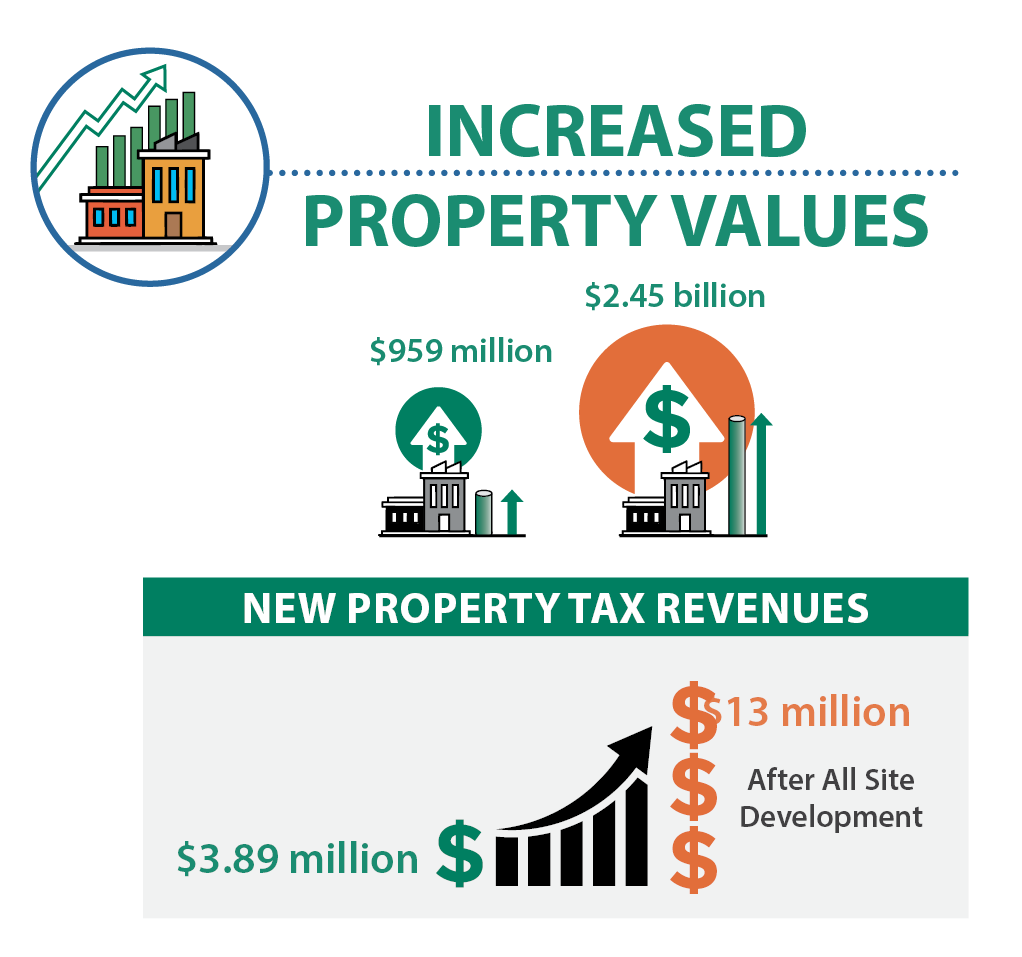
Property values at VBAF recipient sites have increased by an estimated $959 million* to date, transforming former industrial and commercial properties into valuable community assets. If planned developments are realized, the total increase in property value is projected to reach $2.45 billion.
The increase in property values has generated approximately $3.89 million in additional property tax revenue annually. If planned developments are completed, annual property tax revenue is projected to increase to approximately $13 million.
*Based on the subset of 2012 to 2022 grant recipient sites analyzed in the Economic Impact Analysis.
VBAF has awarded nearly $25 million to brownfield properties across Virginia since 2012.