An Ideal Fit for International Defense Contractors
Proximity to federal government, strong veteran workforce make Virginia a natural home for foreign investment in defense
For international defense contractors looking to establish or expand their business in the U.S., there’s an initial pressing question: where to locate the company’s American headquarters?
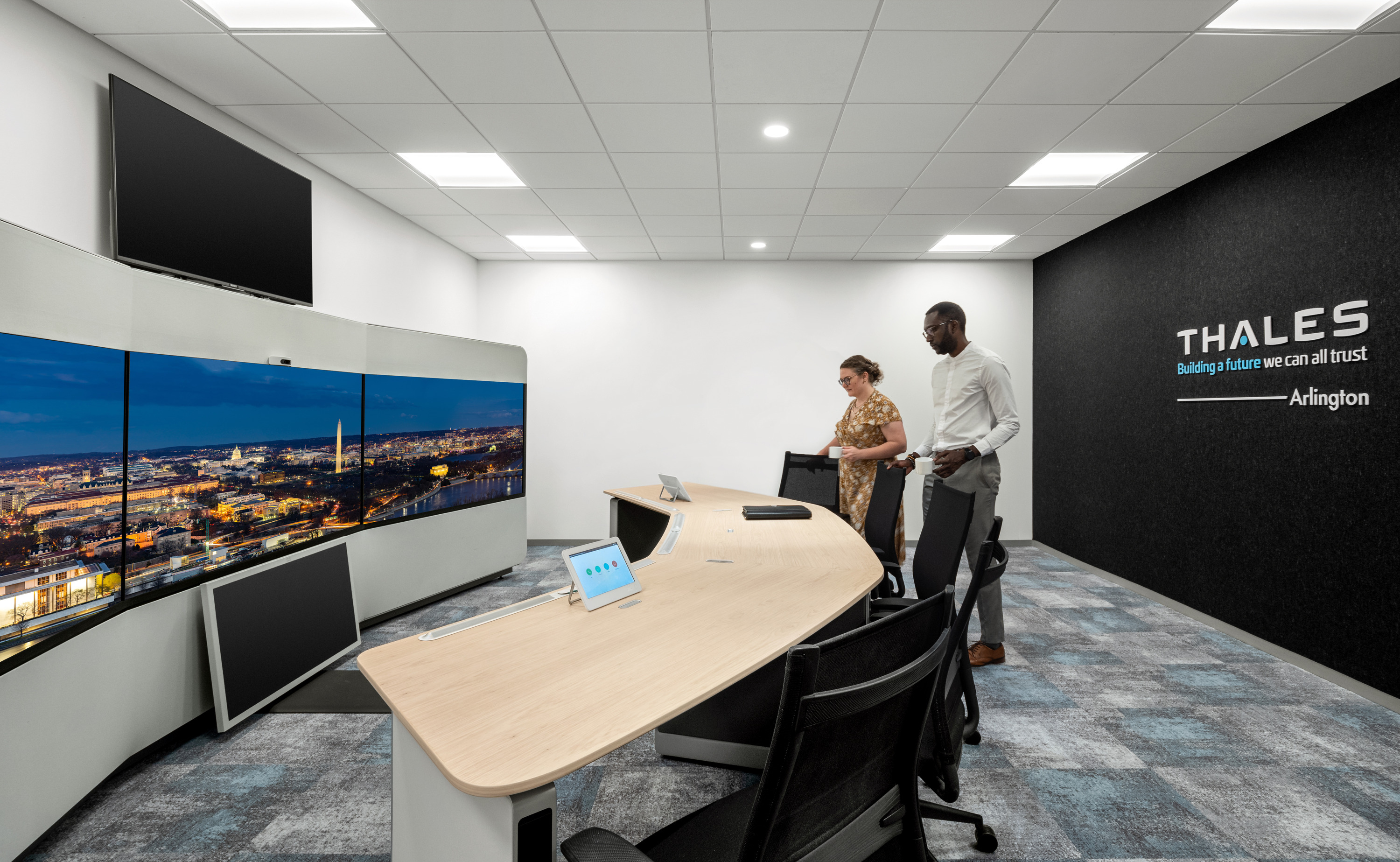
Virginia was and continues to be the obvious answer for Thales Group, a French multinational aerospace and defense corporation. Thales opened an American subsidiary in Arlington County in 1976. Today, the company employs more than 5,000 workers across 41 sites in 18 states, yet the headquarters remains in Virginia — and that’s where it will stay, said Robert Geckle, Jr., CEO of Thales North America.
“Northern Virginia is uniquely important for Thales because it sits at the center of the U.S. national security and policy-making ecosystem,” he said. From the military to federal agencies to lawmakers and the world’s leading defense and technology companies, the vast majority of Thales’ customers, partners, and key stakeholders are nearby.
“Being close to those decision-makers allows us to stay connected to evolving mission needs, priorities, and policy discussions in real time,” Geckle said.
Numerous other international companies have made similar U.S. headquarters decisions:
- Dutch-French aerospace and aviation company Airbus, headquartered in Arlington County
- British aerospace and defense company BAE Systems, headquartered in Falls Church
- German motion control sensor manufacturer Kollmorgen, headquartered in Radford
- Danish aerospace and aviation company Satair, headquartered in Fairfax County
Virginia was also the answer recently for KONGSBERG US, the American subsidiary of a Norwegian defense contractor looking to establish a North American missile production facility after supplying munitions to the U.S. military, on and off, for more than a century. The company selected James City County in Hampton Roads, near Williamsburg, for the facility.
“What KONGSBERG US decided to do in 2024 was have an American company that can support their exports, but also be domestic,” said Heather Armentrout, a former Northrop Grumman employee who is the company’s first U.S. president and general manager.
A ‘Startup’ Mentality From a Mature Company
To launch what Armentrout termed “a startup operation inside a 212-year-old company,” KONGSBERG needed to build up a C-suite capable of both doing business with the U.S. military and communicating effectively with executives back in Scandinavia. That started with Armentrout herself, a longtime resident of Arlington.
As a U.S. Central Intelligence Agency officer from 1997–2012, “I worked all the crises that existed in the world,” including the fallout from the September 11 attacks, Armentrout said. She retired from the agency and soon landed at Northrop Grumman, where she continued to serve national security while utilizing skills she acquired in her work around the globe.
“My life has been being the Rosetta Stone, by being able to understand the American context and whatever international context I’m operating in, and do the translation,” she said.
She’s looked for similar qualities in the executive hires she’s drawn from Northern Virginia’s deep pool of talent, she said.
“There’s a cultural, emotional intelligence, and training that comes with the ability to move between cultures and translate one culture to another,” Armentrout said. “You can’t teach that. You need people who have lived it.”
Those people — former national security, diplomatic, and military personnel, as well as executives with experience in international defense work — are most likely to be found in Northern Virginia, she said.
A Mission-Ready Workforce
Thales particularly values the wealth of veterans that the entire state has to offer. This includes former three- and four-star generals retiring from Pentagon jobs, as well as those moving on from careers at the Commonwealth’s 30 military bases and installations, which represent every branch of the U.S. armed forces.
Whether officer or enlisted, veterans have lived the missions Thales’ customers are trying to accomplish, Geckle said. “They understand operational requirements, emerging threats, and the realities of deploying and sustaining capabilities in the field,” he said. “Their experience helps us better anticipate customer needs and ensure we’re focused on technologies that solve real-world problems.”
Virginia is home to more than 170,000 veterans under the age of 45, and more than 15,000 service members exit the military each year in the Hampton Roads region alone. More than 42,000 Virginians report having some type of security clearance on their professional profile, the highest number of any state in the country, according to Lightcast data. Many of these employees are already familiar with federal contracting and procurement procedures.
Thales has coordinated with federal programs like the U.S. Department of War’s SkillBridge to help it onboard professionals post-military service, and has taken advantage of the “strong support ecosystem available through organizations like VEDP,” Geckle said.
“Proximity to these folks in Virginia creates opportunity to partner with veterans looking to remain connected to the defense and national security community,” he added.
That’s a key reason why KONGSBERG chose to locate its latest U.S. defense assembly plant in Virginia, Armentrout said.
“It’s the talent pipeline, first and foremost,” she said. “Virginia is focused on doing the right thing for the warfighter.”
The 150,000-sq.-ft. facility in James City County will employ nearly 200 people when it opens. For KONGSBERG, coordination began at the federal level — Armentrout said Rep. Rob Wittman was particularly helpful.
Thales, too, considers Virginia’s congressional delegation a meaningful asset. The delegation “is deeply engaged on national security, defense, intelligence, and federal workforce issues,” Geckle said. “That means working in a region where elected officials have a strong understanding of the operational requirements, industrial base challenges, and technology investments that underpin many of the technologies we offer.”
Bipartisan Support for the Defense Industry
Across the board, KONGSBERG has found a happy “synergy” between the federal, state, and local level of government in Virginia. “When we have permitting problems or anything else that might come up, I have an infrastructure and a group of people that are ready to help me break down either the bureaucracy or help me through the challenges,” Armentrout said.
“In this state, it’s substance first, politics second,” she said. “We’re not Republican or Democrat. We’re what’s best for either national security or Virginia. That’s the lens people look through here.”
For the facility itself, James City County, adjacent to Williamsburg, offered attractive amenities like affordable housing and a good school system, which KONGSBERG desired, she said. Plus, the site is in a desirable location close to Naval Weapons Station Yorktown, where Kongsberg will lead booster warhead integration for the explosives it produces.
You get the benefit of proven global innovation while strengthening domestic production and supply chain resilience. That’s why we believe this is an opportune moment for companies with both international expertise and an established U.S. footprint to contribute to America’s defense and security objectives.
Robert Geckle Jr.
CEO, Thales North America
From R&D to Production
This is a great time for international companies to make such investments in U.S. facilities, Geckle said.
“There is a growing emphasis on expanding [domestic] production capacity, strengthening the defense industrial base, and delivering proven capabilities to warfighters more quickly,” he said. “Companies like Thales can bring allied technologies that are already field-tested and proven, then enhance and innovate on them in America for U.S. customers.”
Manufacturing products here means accelerating deployment times, reducing risk, and lowering costs, and that “creates a powerful combination,” Geckle said.
“You get the benefit of proven global innovation while strengthening domestic production and supply chain resilience,” he said. “That’s why we believe this is an opportune moment for companies with both international expertise and an established U.S. footprint to contribute to America’s defense and security objectives.”
Armentrout echoed Geckle’s assertion about supply chain resilience. The more international companies open production facilities in the United States, the stronger the domestic supply chain and the less vulnerable it becomes to crises abroad. “There’s a flow-down from the prime contractor to the supply chain, and we’re working to invest in and build up that resilience,” she said.
For international companies trying to enter or increase their share of the U.S. defense market, building up U.S. capabilities also just makes common sense.
“The way I think about it is, follow the flow of defense dollars,” Armentrout said. “Less than 10% goes to imports, and 90% goes to domestic companies. So, if you want to be a domestic company, you certainly have a lot more opportunity.”
And locating that company’s headquarters in Northern Virginia increases the opportunity for success on multiple levels, Geckle said.
“Northern Virginia has become one of the nation’s premier technology and innovation hubs,” he said. “The region brings together expertise in cybersecurity, artificial intelligence, digital engineering, cloud computing, space technologies, and advanced communications, alongside a highly skilled workforce and a large network of startups, research institutions, and established industry leaders.”
From its large highly skilled veteran population to its ports, rail lines, and major airport hubs, to its commitment to advanced manufacturing, the Commonwealth creates “an environment where companies can easily scale operations as business needs evolve,” Geckle said. “Virginia offers a combination of advantages that are difficult to match.”