
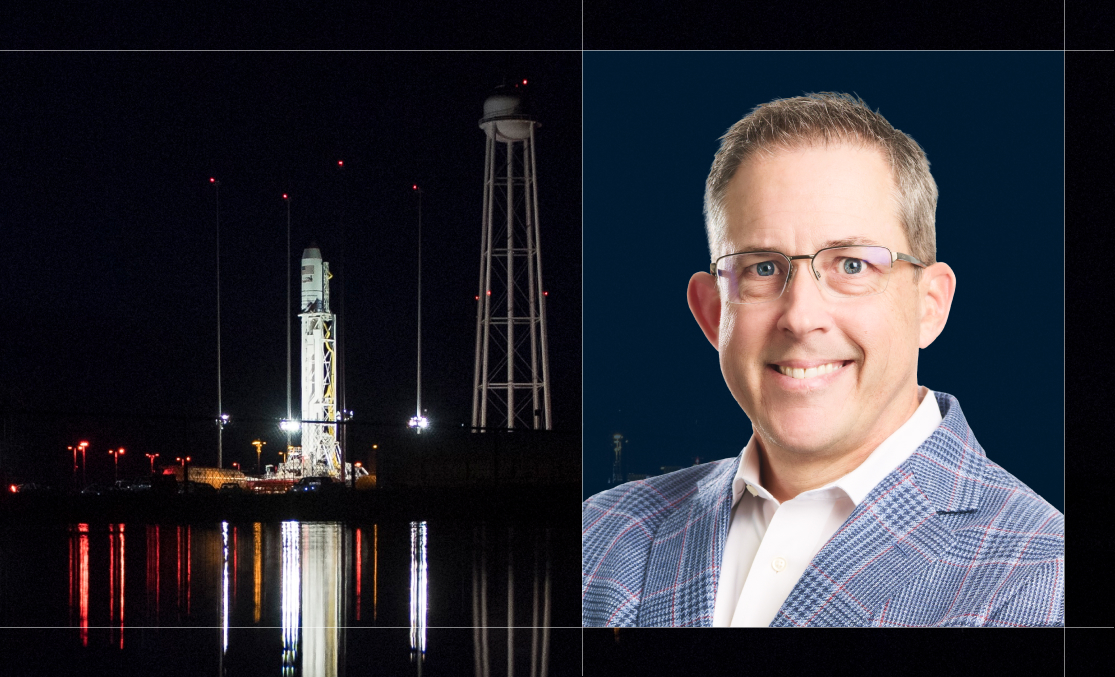
Greg Simer is chief technology officer at Northrop Grumman Corporation, a major aerospace and defense company headquartered in Falls Church, with facilities in Loudoun County, Charlottesville, Waynesboro, and NASA’s Wallops Flight Facility on Virginia’s Eastern Shore. Northrop Grumman is a Fortune 500 company and is one of the defense primes, the companies that maintain direct contractual relationships with the federal government. Northrop Grumman inventions and advancements include the “flying wing” design used in stealth aircraft, the Apollo Lunar Module that carried American astronauts to the moon, and the James Webb Space Telescope, the largest, most powerful telescope in space.
VEDP: Northrop Grumman has been a cornerstone of the defense industry for decades. How do you balance the scale and reliability expected of a major prime contractor with the speed and agility increasingly demanded by today’s national security environment?
Greg Simer: We’re proving that you don’t have to choose between scale and agility. Our corporate headquarters in Falls Church anchors a broad portfolio that includes satellite design, space mission support, and next-generation cyber, software, and electronic warfare capabilities, all backed by nearly 100,000 employees and more than 30 million square feet of manufacturing space nationwide. That scale allows us to deliver highly reliable mission-critical systems.
At the same time, our manufacturing and engineering approach is designed to accelerate the entire lifecycle from design and development through production and testing. We’ve invested heavily in U.S. infrastructure, R&D, workforce skills, and supply chain resilience so we can move quickly, iterate with customers, and field capabilities at the speed the national security environment now requires, without sacrificing quality or reliability.
We recognize that our customers must receive the best solutions as rapidly and affordably as possible. That’s why we routinely team with new entrants and technology partners, integrating their disruptive technologies on our platforms to accelerate capability to the warfighter and stay ahead of the threat. Innovation is embedded in how we operate in Virginia and across the company.
Greg Simer
Chief Technology Officer, Northrop Grumman Corporation
VEDP: There’s a perception that innovation comes primarily from startups and venture-backed defense technology firms. How is Northrop Grumman continuing to innovate while operating at global scale?
Simer: For more than 80 years, Northrop Grumman has redefined what’s possible in aerospace and defense, delivering the breakthrough capabilities our nation needs to deter, meet, and defeat evolving threats. We have not only improved existing systems we have fundamentally reshaped the underlying architecture of air, space, and cyber power, from the flying wing and stealth to advanced electronically scanned radar, space observatories, and cutting-edge microelectronics.
As a leading innovator, we recognize that our customers must receive the best solutions as rapidly and affordably as possible. That’s why we routinely team with new entrants and technology partners, integrating their disruptive technologies on our platforms to accelerate capability to the warfighter and stay ahead of the threat.
Innovation is embedded in how we operate in Virginia and across the company. In Dulles, our teams develop, integrate, assemble, and test civil, commercial, and national security spacecraft and satellite systems, including geosynchronous Earth orbit satellites and the Cygnus commercial resupply spacecraft. In McLean, we’re advancing cyber, intelligence, analytics, and mission solutions that support command-and-control and secure communications. In Charlottesville, we apply additive manufacturing to naval radars, electronic warfare systems, and navigation systems.
These sites bring together multidisciplinary engineering, digital tools, and advanced manufacturing methods under one umbrella. Our scale lets us invest in next-generation technologies such as additive manufacturing, advanced electronics, and software-driven mission systems, and then deploy them across programs and domains. That combination of deep mission experience and modern toolsets enables us to innovate continuously, even as a global prime.
VEDP: What are the most significant changes you’ve seen in the defense market over the last five years, and how has Northrop Grumman adapted its business model or technology strategy to remain competitive?
Simer: Over the last five years, defense customers have placed increasing emphasis on speed of delivery, integration, resilience, and the ability to upgrade systems rapidly as threats evolve. We’ve responded by making our manufacturing and engineering environment more digital, more connected, and more modular.
Our investments in advanced manufacturing, such as additive manufacturing in Charlottesville and the planned advanced manufacturing center in Waynesboro, are part of that shift. They allow us to shorten design cycles, prototype faster, and move from concept to production with fewer handoffs. At the same time, our cyber, space, and electronic warfare capabilities position us to deliver integrated solutions across domains rather than standalone platforms. That evolution keeps us competitive today and aligned with where the defense market is going.
VEDP: As warfare evolves across domains, including cyber, space, autonomy, and electronic warfare, where is Northrop Grumman investing today to solve the challenges of tomorrow?
Simer: In Virginia alone, you can see the breadth of our investments. In Dulles, we’re developing and testing spacecraft, satellite systems, and mission payloads that underpin space resilience and logistics, including the Cygnus commercial resupply spacecraft. In McLean, we’re advancing cyber, intelligence, analytics, and mission solutions that safeguard command-and-control and secure communications. In Charlottesville, we apply additive manufacturing to naval radars, electronic warfare systems, and inertial navigation systems. Across these sites, we’re investing in manufacturing technologies that support our men and women in uniform. The goal is to deliver integrated capabilities that strengthen national security across all domains for today’s missions and for tomorrow’s contested environments.
VEDP: Northrop Grumman is expanding its advanced manufacturing footprint in Virginia through the Blue Ridge Advanced Manufacturing Center in Waynesboro. How does that facility incorporate digital manufacturing, automation, robotics, and advanced testing capabilities?
Simer: The Waynesboro facility is being built as a state-of-the-art advanced manufacturing center. It’s designed from the ground up to be a digital, highly automated environment that integrates design, fabrication, assembly, and test.
We’re bringing together automated production equipment, robotics, and advanced inspection and test capabilities in a connected “smart factory” setting. That allows us to move seamlessly from digital design to digital manufacturing, capture data at every step, and use that insight to improve quality, yield, and speed. Waynesboro will be a key hub demonstrating what advanced manufacturing looks like in the Commonwealth.
VEDP: Increasingly, defense acquisition is focused on speed, production scale, and execution. How is Northrop Grumman leveraging advanced manufacturing and digital engineering to compress timelines from concept to deployment?
Simer: Our approach to manufacturing is explicitly designed to accelerate the entire process, not just the factory floor. By combining digital engineering with advanced manufacturing, we can move from concept to design, prototype, and fullrate production far more quickly.
Our facilities use digital models and connected production systems to enhance our processes. Additive manufacturing lets us iterate designs rapidly, while automation and robotics shorten cycle times in production. As a result, we can deliver complex systems such as spacecraft, electronic warfare equipment, and navigation systems on tighter timelines and at higher volumes, meeting acquisition demands for both speed and scale.
VEDP: What lessons can other manufacturers learn from the defense sector’s adoption of smart factory technologies and digital production environments?
Simer: One key lesson is that smart factory technologies are most powerful when they’re integrated across the entire value chain. Across the Commonwealth, we use digital tools not just on the factory floor, but in design, supply chain management, and test and evaluation. By connecting design models, production equipment, and quality systems, manufacturers can capture data end to end and use it to improve throughput, reliability, and sustainability. Another lesson is that workforce investment is essential. Our advanced manufacturing centers rely on highly skilled technicians, engineers, and operators who can work alongside automation and robotics. When manufacturers pair smart technologies with strong workforce development, they can achieve both higher productivity and better resilience. These are benefits that translate across industries, not just defense.
VEDP: How do you see the relationship between large primes and emerging defense technology companies evolving over the next decade?
Simer: Over the next decade, the relationship between large primes and emerging defense technology providers will become even more important to delivering advanced capability at speed. At Northrop Grumman, we see partnership as a competitive advantage and a mission imperative. We bring deep mission understanding, proven system integration, and the ability to scale, certify, and field capability in demanding operational environments. Emerging technology companies often bring breakthrough innovation, software expertise, and differentiated technical approaches.
The most effective outcomes will come from bringing those strengths together early and deliberately. We know we cannot do it alone, and we don’t try to. We actively seek out partners whose expertise can help us move faster, solve hard problems, and deliver better outcomes for customers. Just as importantly, companies want to work alongside Northrop Grumman because we know how to turn promising technology into trusted operational capability.
VEDP: Virginia consistently ranks among the nation’s strongest aerospace and defense talent markets, with one of the highest concentrations of veterans, security-cleared professionals, engineers, and technical workers. How does that talent base support Northrop Grumman’s operations and growth?
Simer: The Commonwealth’s talent base is a major reason our corporate headquarters and multiple sites are located here. We rely on a deep pool of engineers, cyber professionals, manufacturing specialists, and security-cleared experts to deliver complex systems.
This talent enables us to support thousands of high-tech jobs and work with more than 480 supplier partners across the Commonwealth, generating over $7.3 billion in economic impact in 2025 alone. Veterans and cleared professionals bring critical mission experience, while engineers and technicians power our advanced manufacturing and R&D efforts. Together, they make Virginia a cornerstone of our operations.
We actively seek out partners whose expertise can help us move faster, solve hard problems, and deliver better outcomes for customers. Just as importantly, companies want to work alongside Northrop Grumman because we know how to turn promising technology into trusted operational capability.
Greg Simer
Chief Technology Officer, Northrop Grumman Corporation
VEDP: What skills are most critical for the future workforce supporting your mission areas, and how are those needs changing?
Simer: As we expand our work, several skill sets are especially important. We need engineers and technologists who are fluent in digital engineering, model-based systems engineering, software development, and data analytics. We also need manufacturing professionals who can operate and maintain automated equipment, robotics, and additive manufacturing systems. The skills mix is evolving from traditional manufacturing and engineering roles toward hybrid profiles that combine domain expertise with digital fluency. In Virginia, we’re focused on developing and attracting talent that can work in these environments.
VEDP: Northrop Grumman has long-standing partnerships with universities and STEM programs across Virginia. What role do those initiatives play in developing the next generation of engineers, technologists, and manufacturing professionals?
Simer: Our partnerships with Virginia universities and STEM organizations are central to building the pipeline of future talent we need. Through internships, coops, research collaborations, and STEM outreach, we give students exposure to real mission challenges in areas like space systems, cyber, and advanced manufacturing.
These initiatives help students build relevant skills, understand career paths in aerospace and defense, and see how their work can contribute to national security. For Northrop Grumman, they ensure we have a steady flow of engineers, technologists, and manufacturing professionals ready to step into roles at our Virginia sites, sustaining the region’s position as a leading aerospace and defense hub.
VEDP: How important are veterans and transitioning service members to Northrop Grumman's workforce strategy, and what value do they bring to the company?
Simer: Nearly 20% of Northrop Grumman’s workforce are veterans and reservists, reflecting our strong support for military talent and leadership. Along with strong experience and values instilled in them over careers in the military, they bring a commitment to continue serving through our company. Veterans and transitioning service members are vital to our workforce strategy, particularly in a state like Virginia with a high concentration of military installations and cleared talent. They bring firsthand operational experience, an understanding of missions, and a deep appreciation for reliability and readiness. Northrop Grumman participates in programs like SkillBridge, which offers service members civilian work experience during their last six months of service, supporting career transition with high full-time employment rates in mission-critical roles.
Our Virginia operations help ensure that the technologies we develop are aligned with real-world needs. Their leadership, discipline, and mission focus strengthen our teams and underpin our ability to deliver systems that truly support the warfighter.
VEDP: How does Virginia’s combination of proximity to federal decision-makers, research institutions, military installations, and cleared talent create competitive advantages for your business?
Simer: Virginia offers a unique combination of assets that directly benefits our business. Our corporate headquarters in Falls Church keeps us close to federal decision-makers and partners. Nearby research institutions and universities provide access to cutting-edge ideas and a strong pipeline of STEM talent. The state’s military installations and concentration of security-cleared professionals give us access to mission-experienced workforce and customer communities.
This ecosystem supports our operations throughout the Commonwealth and the result is a competitive advantage in understanding customer needs, recruiting top talent, and rapidly transitioning technology into fielded capability all from a strong base in Virginia.