A Space for Innovation to Flourish in Northern Virginia
National Innovation Quarter connects people and speeds deployment of emerging technology
Northern Virginia offers technology companies a number of advantages: proximity to federal buyers, decision-makers, and policymakers, access to leading talent and a steady pipeline of technical graduates, and robust infrastructure to support computing and connection. Now, through the new National Innovation Quarter (National IQ), emerging technology innovators, investors, and federal and corporate buyers have an entity committed to helping them connect, accelerating the journey from discovery to deployment.
National IQ is a new landmark innovation district that stretches across Arlington and Alexandria, encompassing the neighborhoods of Crystal City, Pentagon City, and Potomac Yard. Within its boundaries fall coworking, meeting, and warehousing space, as well as leaders in academia, entrepreneurship, government, and industry. The Pentagon, Amazon’s HQ2, the Virginia Tech Institute for Advanced Computing (IAC), the National Science Foundation, and the U.S. Patent and Trademark Office operate here, surrounded by global leaders such as Boeing and L3Harris.
Since the nonprofit’s launch in February 2026, the National IQ board has shaped programming focused on the national security domain, curated to serve a diverse audience of startups and founders, venture capital and investors, accelerators, and prime contractors.
“National IQ was established to be the connective tissue of an ecosystem — a place where builders across government, industry, academia, and startups converge to solve the most consequential problems facing our nation,” said Michael Manuccia, who was hired in September as the district’s first CEO.
“Northern Virginia has an incredible technology ecosystem already,” said Anna Nissinen, chief economic development officer at Arlington Economic Development. “There are over 20,000 technology firms here innovating, working in conjunction with the federal government and research institutions.”
These organizations may have a long history in the region, but today’s pace of technological change is transforming the development and procurement cycles they’ve had in place.
“We are in this transformational moment as an economy in the greater Washington region,” Nissinen said. “AI is completely reshaping the technology landscape. Layer on top of that quantum technologies, which I believe will be commercialized in the next four to five years, and you see another transformational impact.”
National IQ was established to be the connective tissue of an ecosystem — a place where builders across government, industry, academia, and startups converge to solve the most consequential problems facing our nation.
Michael Manuccia
CEO, National Innovation Quarter
The Resources to Succeed
Federal agencies and corporate leaders are already redefining the way they work in response to this challenge. What sets National IQ apart is the intentionality with which it is creating a continuous feedback loop between developers, buyers, and backers to ensure breakthrough technologies don’t just emerge, but scale.
“It’s this intentional convening and collision of investors, employees, and the large corporate partners who want to find the next technology,” said Marian Marquez, senior vice president of the Alexandria Economic Development Partnership.
“There’s enormous power in collective convening,” said Michael Hauser, managing partner at SAIC Ventures and board chair for National IQ. “This does not work without a sense of place.”
Unlike other innovation districts, National IQ is not centered on a single building or campus. The organization is instead building programming that gives entrepreneurs, investors, and established corporations reason to convene across existing locations within the region. The multiplace, many-spaces model encourages activity across offices, university facilities, partner locations, convening spaces, and a forthcoming innovation lab.
Part of a $4 million GO Virginia grant awarded to support National IQ’s launch will fund creation of an innovation lab in Potomac Yard, which is already home to Virginia Tech’s IAC. The space will give Virginia Tech, one of the founding forces behind National IQ, a place to prototype, test, and demonstrate emerging technology to partners flying into Northern Virginia’s commercial air hubs. The existing campus is already driving research in AI, quantum computing, and other areas of advanced research. With this funding, it will soon be easier for partners to see this research in action.
“We’re shortening the distance between the people who are able to move innovation forward,” Nissinen said. “Not only proximity-wise, but by bringing together those decision makers — the investors, the research institutions, and the innovators — to move things forward faster, National IQ is closing the proximity gap.”
University Partners Enhance Innovation
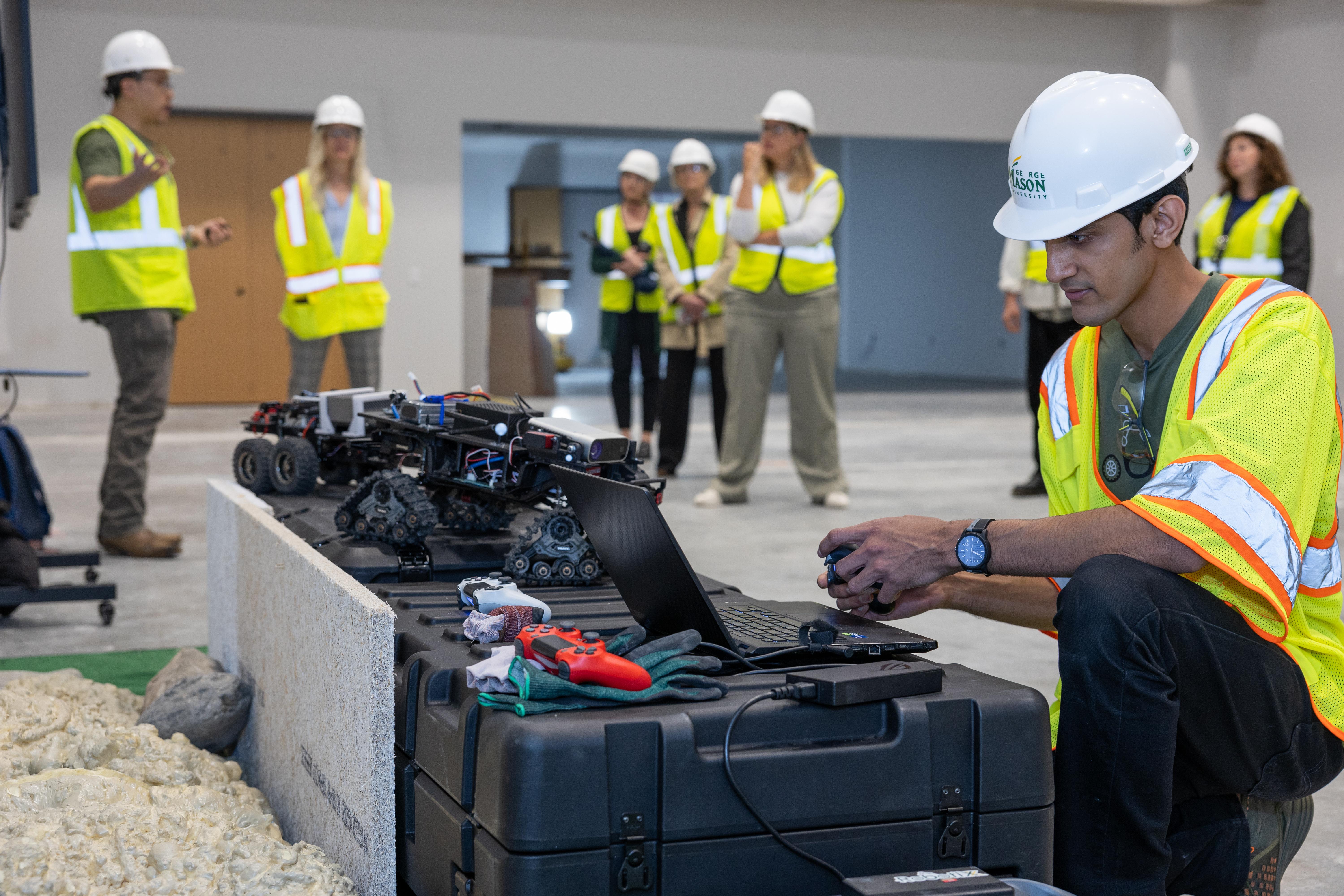
An essential component in this equation are the students fueling the long-term workforce pipeline. Through higher education institutions like Virginia Tech’s IAC and local campuses for George Mason University, the University of Virginia, and others, the region is matriculating approximately 90,000 graduates each year. Marquez adds that the IAC’s more than 45 graduate degree and certificate programs expect to add to the workforce 600 highly specialized graduates each year.
“National IQ is a natural partner with George Mason to continue to advance innovation and collaboration across the region,” said Amy Adams, executive director of George Mason’s Nexus234 innovation district in nearby Prince William County. “It means a company can plug into a whole network, connecting three counties, instead of a single address. Every one of these districts makes the others stronger, and the Commonwealth of Virginia is the real beneficiary.”
Building this pipeline also relies on local initiatives to strengthen STEM interest in K-12 education. For example, Alexandria Economic Development has begun working with the city’s school system to ensure that skills to serve in-demand industries are being built into the K-12 continuum. Preparing students to succeed in the area’s most in-demand fields benefits job seekers as well as local industry.
“When you think about it in terms of the opportunity that it represents for companies looking for tech talent or to grow their employee base in those fields, it’s pretty unparalleled,” Marquez said.
For those students and other individuals who go on to create the next big thing in tech, National IQ provides essential resources to scale those ideas. Those resources include access to four accelerators, also funded by the GO Virginia grant. Startup programs to help entrepreneurs scale technologies and access new markets will also be available.
One of those accelerators is Fuse Ventures, a platform built to screen, accelerate, and scale startups.
Fuse Ventures is “engaging in both regional and topically focused accelerators all around the country,” Hauser said. “Guess where they’re going to do their showcases? We can convene the ecosystem here and with customers and potential partners.”
Nissinen added that resources like these “are aimed toward scaling emerging technology startups and connecting them to the opportunity that exists.” Startups in the early stages of establishing their seed grounds need access to opportunity, and many first think of Silicon Valley. “We’re now bringing all that together here for them to access,” she said.
National IQ founders envision a range of events to serve this goal, from workforce and student engagement, to coaching, capital access summits, pitch events, and more.
“It doesn’t matter whether you’re doing hard tech or AI, quantum computing, or personnel training — we want to make sure we’ve got enough variety that there are collisions of those worlds that are going to create unique opportunities,” Hauser said.
Engaging the Defense Community
To date, programming has included activities such as the Missions + Markets event series for defense and dual-use technology stakeholders, VC in DC networking events, and a demo of Brave1, the Ukrainian government’s defense technology cluster helping to scale combat-proven technologies.
The district also offers soft landing programs for international startups looking for access to the U.S. market, including the Arlington Tech Launchpad, aimed at high-potential aerospace, defense, cybersecurity, and related industries.
“This will be a groundbreaking program to attract foreign direct investment,” Nissinen said. “We are such an attractive market for foreign direct investment. Even though the geopolitical environment is volatile, we see investment coming in. However, it needs a physical place to land, where all of these assets come together to make it easy for them to enter the market and capitalize on the opportunity.”
Through this, National IQ aims to become a go-to destination for global leaders to find and create emerging technology.
As Nissinen puts it, “We’re elevating not only national competitiveness, but our competitiveness on the global stage.”