Supporting Defense and National Security in Central Virginia
University of Virginia programs, thriving intelligence sector make region an industry hotspot
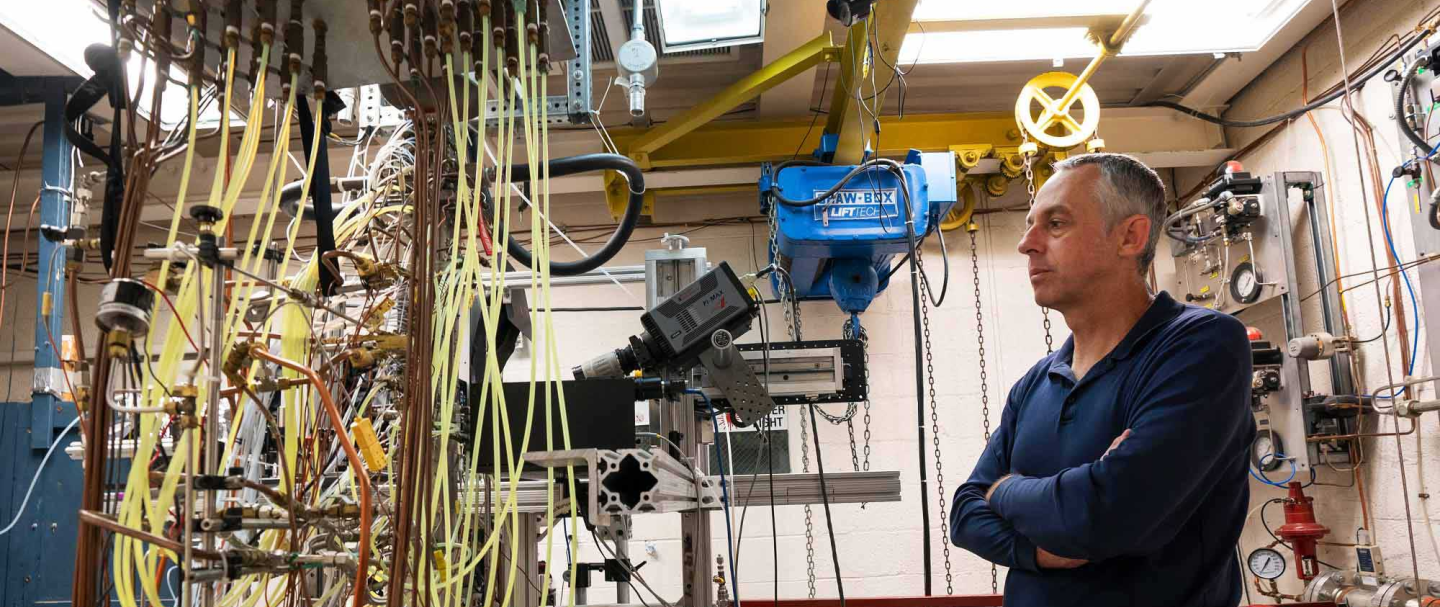
Within the Hypersonics Research Complex at the University of Virginia (UVA), 17 faculty members from four departments test propulsion and materials concepts and help advance hypersonic flight technology. They use computer models and specialized wind tunnels to conduct simulations and validate hypotheses. They experiment with materials positioned on the leading edge of aircraft wings, materials that can reach thousands of degrees as planes and missiles hurtle through the air at five times the speed of sound.
Over the last five years, UVA has worked with institutions across the country as part of a national thrust to develop those technologies more quickly. Supported by the federal government, universities conduct applied research that they can easily hand off to industry partners to address specific Department of War (DoW) requests.
“We have a better understanding of the national security needs,” said Christopher Goyne, lead faculty member for UVA’s Hypersonic Research Complex and director of the Aerospace Research Laboratory. “Solutions that we develop can be more suited to those needs and constraints in terms of application of the technology.”
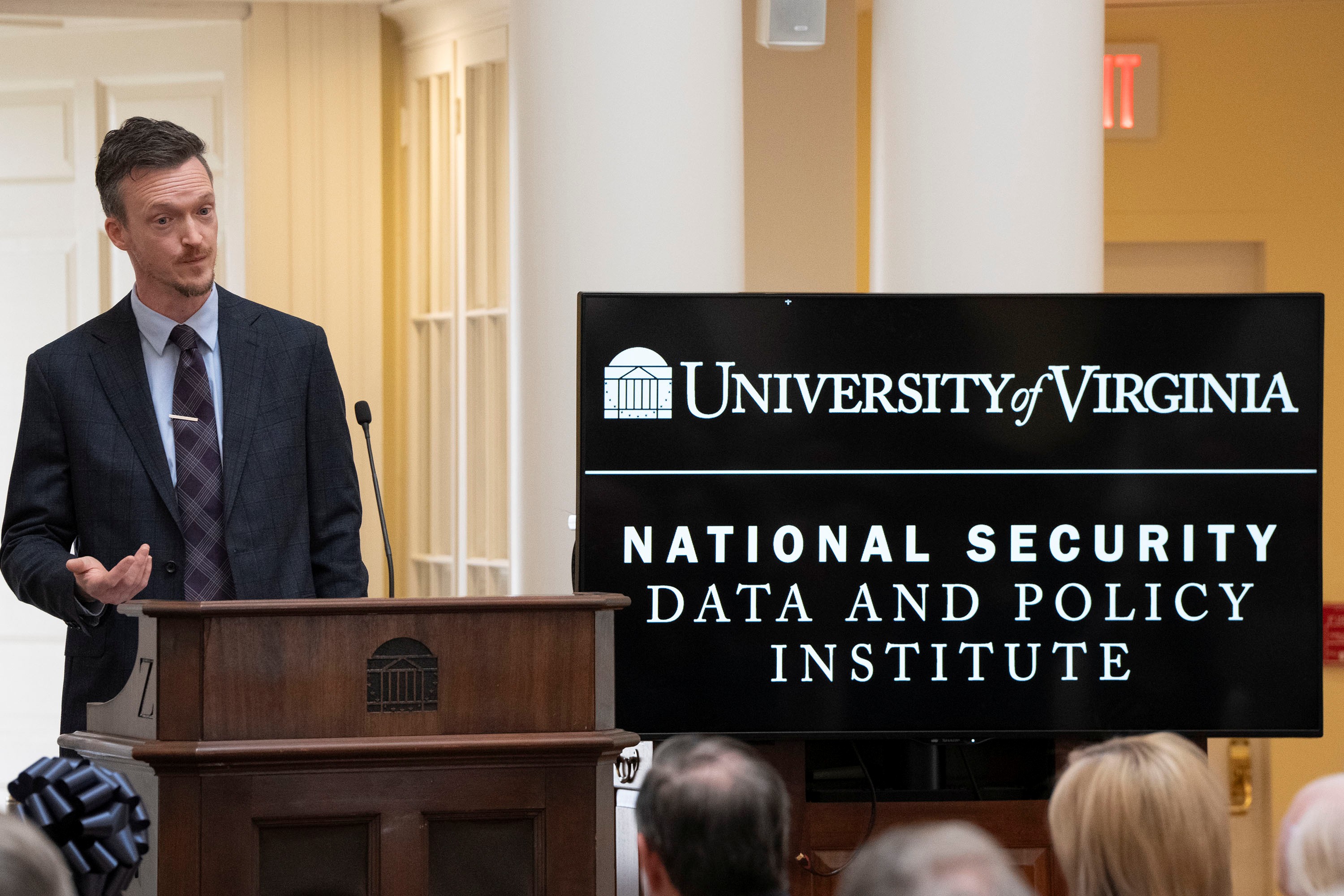
The effort is one of a few recently undertaken by UVA to support defense and national security. In addition to the Hypersonics Research Complex, the university competed for and received a $20 million federal award to launch the National Security Institute (NSI) in collaboration with the Office of the Director of National Intelligence (ODNI).
Capitalizing on Faculty Expertise
The NSI draws on the expertise of UVA professors to address national security issues ranging from artificial intelligence and machine learning to cybersecurity and critical infrastructure. The institute now has several new contracts with the intelligence community and DoW to investigate and research emerging technologies and adversary threats. Researchers and staff at the NSI have helped streamline monitoring and compliance for various levels of government, conducted research in collaboration with the Rivanna Station intelligence cluster, and worked on training and exercises for senior leaders.
One of these new contracts comes from the U.S. Army Corps of Engineers. This $7 million grant will help the NSI support resilience and readiness at Naval Station Norfolk, the world’s largest naval base and the home port of the U.S. Fleet Forces Command. NSI researchers are developing solutions for flooding that incorporate natural infrastructure rather than relying fully on man-made structures. Examples include elevating marshes, planting specific types of vegetation, and adding low-profile sills to absorb water while avoiding road obstructions and spillage into equipment.
“When there are documented instances of impacts to readiness based on things like storms and coastal erosion, then we think of designing new types of infrastructure that have greater redundancy, greater capacity to self-heal,” said Michael Luegering, an assistant professor at UVA’s School of Architecture who is working on the project at NSI. “That fits well under the umbrella of national security.”
The project will last at least five years, and possibly longer as experts research and test the most effective methods to slow or lessen impacts of storm surges and coastline erosion.
Recent research at the NSI spans analyses of China’s AI strategy, implications of quantum computing advancements in national security, and public opinion on data center expansion. The institute aims to leverage the rapid pace of technological change and the proliferation of data to create strategic advantages for the United States.
The institute’s efforts to build and maintain relationships with government officials on the local and state level are key to its success, said Dr. Phil Potter, NSI’s executive director. “If you’re not on firm footing with your local partners, then you’re not going to have credibility at the state and national level,” he said. “That’s a big part of the story for both us and for UVA more broadly.”
If you’re not on firm footing with your local partners, then you’re not going to have credibility at the state and national level. That’s a big part of the story for both us and for UVA more broadly.
Dr. Phil Potter
Executive Director, National Security Institute, University of Virginia
Defense Industry Supports Regional Economic Growth
Thanks in part to the NSI’s work to concentrate the efforts of various groups — including organizations like the Arlington County-based Intelligence and National Security Alliance — the city of Charlottesville is rapidly becoming a hub for the defense industry.
The Central Virginia National Security Alliance (CVNSA) recently partnered with Charlottesville technology company Luna Labs, UVA’s NSI and School of Engineering, partners at the Hampton Roads Executive Roundtable, and industry experts in Central Virginia in the in the region’s response to a request for information from the Defense Innovation Unit (DIU). DIU, part of DoW, contracts with companies to develop solutions to national security issues.
The details aggregated by Luna Labs in the Central Virginia response showed potential for the region to support and accelerate defense technology and expand an industry that is positioned to be the second-largest economic generator in the area, according to a 2023 report from UVA’s Weldon Cooper Center. Taken in whole, the exercise of the DIU response for Central Virginia demonstrated the strength of the national security sector in the region amongst higher education, the private sector, and the public sector.
“One of the immediate benefits of the National Security Institute was its ability to galvanize an otherwise fragmented national security ecosystem that currently exists in the Central Virginia region and bring those individual parts and pieces together with mission partners from the national capital region to create a more unified community of national security players, whether from higher education, from industry, or from local government,” said Miles J. Davis II, director of the CVNSA. “What I’ve seen on the economic development side is they’re really exercising their ability to convene the community to address complex issues, which leads to showcasing what this region brings to bear.”
National security and defense projects have also helped startups in those fields tap into and supplement the robust defense ecosystem that already exists in the area, anchored by Northrop Grumman, L3Harris, Booz Allen Hamilton, General Dynamics, CACI International Inc., and the Battelle Memorial Institute.
The Virginia Innovation Partnership Corporation partnered with a number of local universities — including UVA, Virginia Tech, and Virginia Commonwealth University — to create an express licensing agreement to help fast-track startups that spin out from university research.
At UVA, that effort is part of a broader push to connect research, entrepreneurship, industry and national-security partners through UVA Innovates. Led by Paul Cherukuri, UVA’s inaugural Chief Innovation Officer and Donna and Richard Tadler University Professor of Entrepreneurship, UVA Innovates works across the University to help faculty and students translate discoveries into ventures and connect those ventures with the partners, capital, and customers needed to bring new technologies into the world.
“Virginia has an extraordinary concentration of national security assets — from universities and federal agencies to defense companies, entrepreneurs, and investors,” Cherukuri said. “Our opportunity is to connect those pieces into an innovation engine that can move discoveries from the laboratory to the mission faster. UVA is uniquely positioned to help lead that effort.”
UVA’s recent efforts to support more streamlined pipelines from research to development are well positioned to promote that growth, particularly at NSI, Potter said. “We’re very good at identifying folks who have the type of problem we can help with, and then helping with those problems in ways that actually create change.”
As those programs grow and expand, UVA will continue to educate and train students who are interested in entering the national security field when they graduate. NSI now supports an internship program, and aerospace students can participate in the fundamental research UVA has always done.
“We can share that in the classroom with our undergraduate and our graduate students and educate them with knowledge that’s right at the cutting edge of new technologies,” Goyne said. “At the same time, we do research that’s also helping to advance our national security capabilities of the United States.”