Why Aerospace and Defense Companies Thrive in Virginia
How the Commonwealth emerged and demonstrated staying power as America’s military home
Why do defense companies choose Virginia to be their home base? Why do they grow and expand into the Commonwealth? And why do they stay despite constant courting from the other 49 states?
Let’s start with the obvious reason. Sharing a hometown with the Pentagon and the Department of War (DoW) figures strongly into the reasoning behind why defense companies opt to make Virginia home, from bustling startups to the Commonwealth’s well-established industry primes (companies with direct contractual relationships with the federal government). Four of the five biggest defense primes — The Boeing Company, General Dynamics Corporation, Northrop Grumman Corporation, and RTX Corporation — are headquartered in Northern Virginia, with the proximity to the federal government, well-established industry ecosystem, and talent (veteran and civilian) that comes with such a location.
Virginia has ranked No. 1 in federal defense spending among all states every year since 2021, taking into account payroll, contracts, and grants, according to analysis from DoW’s Office of Local Defense Community Cooperation. Based on the surge in demand on Virginia’s defense companies created by recent global events, it’s not relinquishing that honor anytime soon.
Take the recent nuclear submarine contracts awarded to Newport News Shipbuilding (NNS), a subsidiary of HII, and General Dynamics Electric Boat, a subsidiary of the Fairfax County-based prime. The two companies were awarded a combined $76.6 billion for nine Virginia-class submarines, with six to be delivered by NNS, and five Columbia-class ballistic missile boats, an investment the Navy called “a once-in-a-generation recapitalization.”
For another example of the Commonwealth’s pull for defense companies, take Forterra, the autonomous technology company that recently expanded into Arlington County.
“We’re expanding into Virginia because this is where the Department of War sets its direction and where great engineering talent lives,” said Scott Sanders, Forterra’s chief growth officer. “Arlington puts those two things under one roof for Forterra. Being located close to the DoW means we stay congruent with the Pentagon’s strategy, and since our soldier end users are located around the world, our job is to make sure nothing gets lost between what they need and what we build here.”
Forterra, which now has roughly 600 employees and is headquartered in nearby Clarksburg, Md., will use its new Arlington offices as a main hub for its C-suite team, as well as its growth, strategy, engineering, and product teams.
Strategic proximity certainly factors mightily into defense contractors of all sizes’ decisions on where to position their forward-facing facilities, whether inside the Beltway or a stone’s throw from the Hampton Roads region’s maritime and defense assets.
But read between the lines of Sanders and other defense industry leaders and it becomes clear that the innovation ecosystem being built by both up-and-coming and legacy companies is at least an equally important factor for defense outfits seeking a strong home field advantage.
And innovation needs fuel.
I’m particularly interested in people who can operate across those boundaries. Technologists who understand national security, security professionals [who] understand the technology...and certainly those acquisition professionals who understand the aggregate risk.
Jeffrey Spinnanger
Director of Information and Acquisition Protection, Office of the Secretary of War
Virginia’s Talent Show
“It actually does start with the talent piece,” said Heather Armentrout, president and general manager of KONGSBERG US, the U.S. subsidiary of Norway-based KONGSBERG. “The talent is here in Virginia — we thought it would very much meet our needs.”
KONGSBERG US manufactures missile systems and is “a bit of a startup within the [parent] company,” Armentrout said. They’re quickly scaling and growing around the globe, she added, with eight U.S. locations — and a new Virginia presence.
The new $71 million, 150,000-sq.-ft. facility in James City County, in the Hampton Roads region, will be bolstered by an additional $30 million in engineering and software investment when it comes online in 2028. The 180 new jobs will draw from the area’s mission-ready workforce, which conveniently comes complete with critical security clearances and relevant experience, Armentrout said.
Hampton Roads boasts 19 military installations — including Naval Station Norfolk, the world’s largest naval base — and approximately 100,000 active-duty military personnel. The top 10 defense contractors in the country all have a presence in the region, which receives more than $15 billion in federal contracts each year. The region is also home to the only two North Atlantic Treaty Organization commands in North America, both in the city of Norfolk.
Across the Commonwealth, Virginia’s deep talent pool comprises more than 42,000 workers with security clearance listed on their professional networking profiles, according to Lightcast Profile Analytics. Additionally, the Commonwealth touts 151,000 veterans under age 45, good for the fourth-largest population in the country. Currently, more than 36,000 Virginians work in the aerospace and defense industry, and more than 287,000 work in occupations core to that industry.
“There’s going to be a huge veteran population we’re looking forward to engaging,” Armentrout said.
A Responsive Mindset
Of course, private industry isn’t the only one vying for this talent. Uncle Sam also wants them.
“The adversary doesn’t really care about the org chart,” said Jeffrey Spinnanger, director of Information and Acquisition Protection from the Office of the Secretary of War.
In other words, titles, reporting structures, and even who you work for are meaningless once there are boots on the ground or drones in the air.
While pressing that “the mission remains a tremendous advantage” of recruiting a workforce ranging from IT specialists to front-line soldiers, there’s also an increased recognition that careers can weave in and out of the private and public sectors at any time.
“We have to recognize that careers are more fluid today,” Spinnanger said, “and at various points in the careers, not just in these transitory points at the very beginning or maybe at the very end. But how do we tap into talent in a mid-career?”
This answer may reside in the Business Operators for National Defense program, or BOND initiative, which aims to recruit industry experts with deep experience to support the DoW’s overhaul of its acquisition process.
At its launch, Secretary of War Pete Hegseth described the program as “harnessing the best and brightest private sector talent to fundamentally change how we equip our warriors for the future fight.”
Spinnanger layered some nuance into the evolving human capital needs.
“We need great technical talent, certainly, but we also need that workforce to understand the threat environment surrounding the technologies that they’re developing,” he said. “And as it relates to the skills and talent side, obviously AI, cyber engineering, microelectronics, quantum space — all these things matter. And so does security.
“But from our vantage, I’m particularly interested in people who can operate across those boundaries. Technologists who understand national security, security professionals [who] understand the technology...and certainly those acquisition professionals who understand the aggregate risk.”
The DoW’s SkillBridge program is another powerful magnet for attracting talent to the government. The initiative allows active duty service members to complete civilian internships, apprenticeships, or job training during their final 180 days of military service.
A Rising Tide of Innovation
Staffing up the military-industrial complex is about more than matching the right talent with the right needs. It extends to creating an environment in which innovation is given room to breathe, bubbling into an ecosystem that spans sectors, cuts through red tape, and opens silos.
That’s exactly what additive manufacturing startup Radian Forge and CEO Jeff Yeager are up to. The leader of the Portsmouth-based company, which builds massive parts with large-format printers, including rudders and propellers for the Navy, passionately believes that location is critical to innovation.
“This work was happening everywhere except for where it was needed,” Yeager said. “We chose to build Radian Forge in the heart of American shipbuilding.”
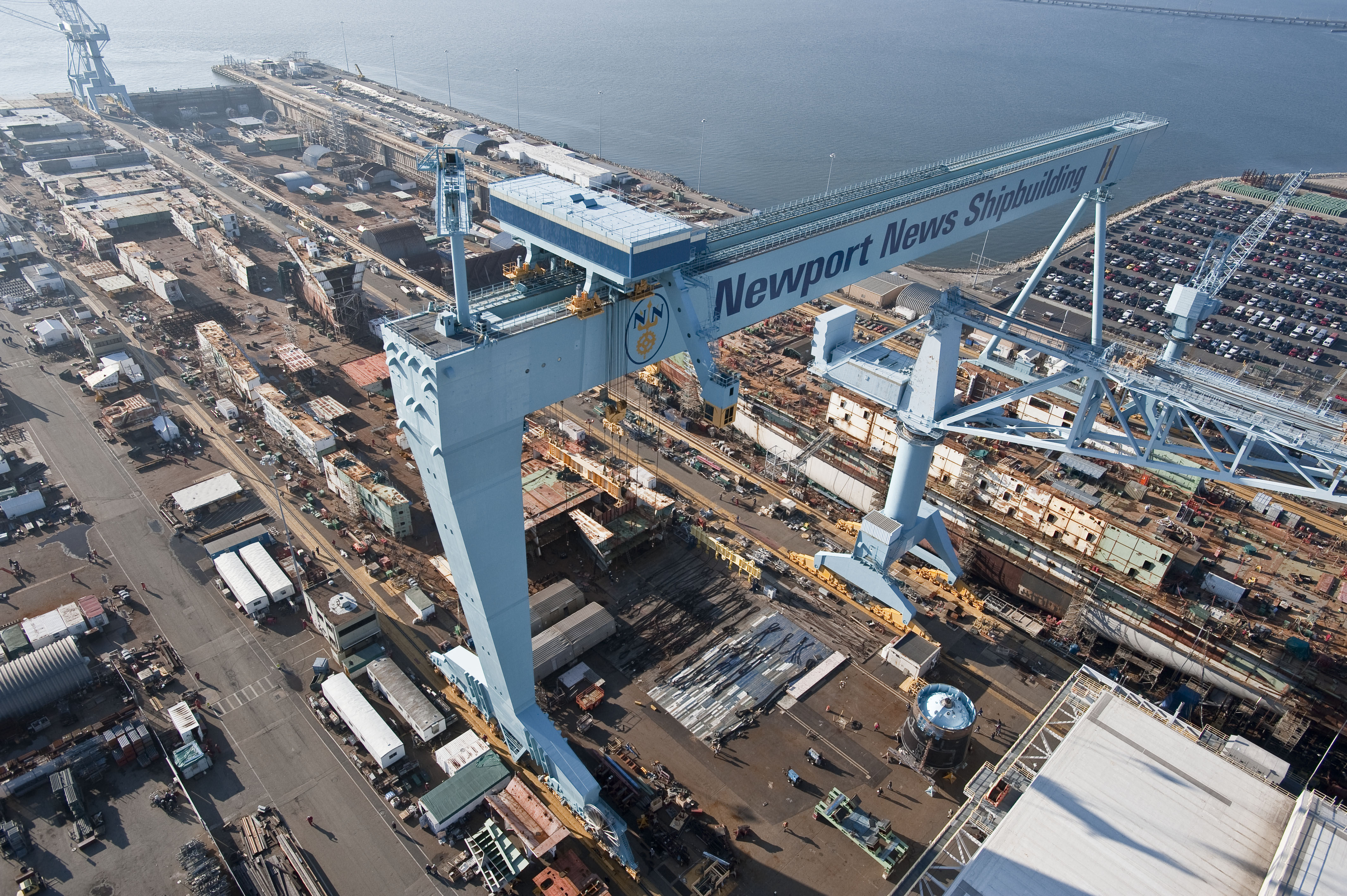
“The heart of shipbuilding” might be understating things. Business Facilities ranked Virginia the No. 1 state for the maritime industry in its recent state rankings, owing to the country’s largest shipbuilding and repair industrial base. Newport News Shipbuilding is Virginia’s largest industrial employer, with about 26,000 employees in the Commonwealth. It has delivered more than 800 ships to commercial and military customers over its 140-year history and built all 11 of the Navy’s nuclear-powered aircraft carriers.
Yeager’s plan for Radian Forge is to master printing parts in a factory environment so that the startup can seamlessly pivot to a wartime environment; for example, printing parts on a beachhead to perform “battlefield triage” on equipment.
“I want this to be the match that lights what needs to happen next,” he said.
Part of Radian Forge’s innovation is its intuitive approach to workforce training.
Yeager said that two of his best operators don’t have college degrees, and that it’s simple to learn the intuitive process of operating his 3D printers.
“It’s intuitive, like using an iPad,” he said. “Give us someone with digital instincts and they can thrive.”
He sees his company as being a catalyst for upskilling the workforce not just in the Hampton Roads area, but well beyond.
“We’re not trying to eliminate jobs,” he said. “We’re using automation to fundamentally change what these jobs can accomplish.”
Just down the road in James City County, KONGSBERG US is letting the world know innovation is a driving force from the get-go. Armentrout rattles off a long list of the Commonwealth’s home field advantages: the cost and reliability of doing business, a streamlined permitting process, reliable sources of power, effective political leaders, a moderate climate, top-flight schools, strong seaports and airports, and a high quality of life.
“It felt very right. People will have a good life here,” Armentrout said.
Then there are proven practices they’re importing from their home country.
“There’s an art to it,” she said. “There is a degree of things we want to maintain from our Norwegian culture. Paying for health benefits is a Norway value.”
There is also an effort to operate nimbly with a flatter hierarchy. This blend of Norwegian and American culture has led to one of the best employee retention rates in the defense industry, Armentrout said.
The government has also shifted its thinking to maximize efficiency.
“We need to innovate faster, get capabilities to warfighters faster,” Spinnanger said.
One way the DoW is replicating the speed of industry is by following the Adaptive Acquisition Framework, which is a strategy for designing, developing, and delivering effective and affordable capabilities at the speed of relevance.
Spinnanger said, “In [President Donald Trump’s] first administration, the department underwent pretty substantial acquisition reforms that were designed to create way more agility in the various ways that acquisitions can happen.”
In order to bring innovation to the front lines faster, the government also embraced nonlinear workflows in favor of simultaneous manufacturing processes.
“The reality is that these need to be parallel processes, not sequential ones,” Spinnanger said. “Security, in particular, can’t be the last stop after a technology is developed...If innovation is going to move forward at commercial speeds, the bottom line is that security needs to move at that speed as well.”
This innovative framework also applies to how assets are protected from adversaries, Spinnanger said.
“The weapon system is really the end of a much, much larger ecosystem. Underneath it is networks and cloud infrastructures, manufacturing, energy, logistics, supply chains, facilities,” he said, adding that an adversary can impact a capability at any of those touchpoints.
“They may be able to undermine a capability without ever touching the actual weapon system itself,” he said.
The talent is here in Virginia — we thought it would very much meet our needs.
Heather Armentrout
President and General Manager, KONGSBERG US
Leading the Pack
“Our goal has always been to build manufacturing capacity on all the major coasts,” Yeager said.
The company is already working on future expansions of its presence in locations ranging from San Diego to Australia. Yeager plans to have 50 people on staff and more than $10 million in assets in the next year and a half. Radian Forge is a model for success that can and should be replicated, he said.
“America needs hundreds of companies like Radian Forge building advanced manufacturing capability,” Yeager said.
Forterra, fresh off a $238 million Series C funding in November 2025, plans to bump its ranks past 650 by the end of the year.
So, why do defense companies choose Virginia? Because Virginia and the defense companies that call the Commonwealth home have been in lockstep coordination with one another to welcome and support ongoing growth — and will continue to do so moving forward.
“Radian Forge’s decision to grow in Portsmouth reflects a clear mission alignment with the Commonwealth of Virginia,” Yeager said when the company announced its recent expansion. “The region’s shipbuilding heritage, technical workforce, and direct access to the fleet make it the right place to scale advanced manufacturing capabilities that matter to national defense.”