Only the Best Is Good Enough: The LEGO Group Chooses Virginia for U.S. Manufacturing Facility
Summary
- $1 billion investment to build a 1.7-million-square-foot precision manufacturing facility in Chesterfield County — LEGO's only U.S. manufacturing plant — is expected to create more than 1,760 new jobs by the time it opens in 2027.
- This strategically located facility allows the company to shorten its supply chain by producing bricks closer to its growing North American market, reducing transport-related emissions.
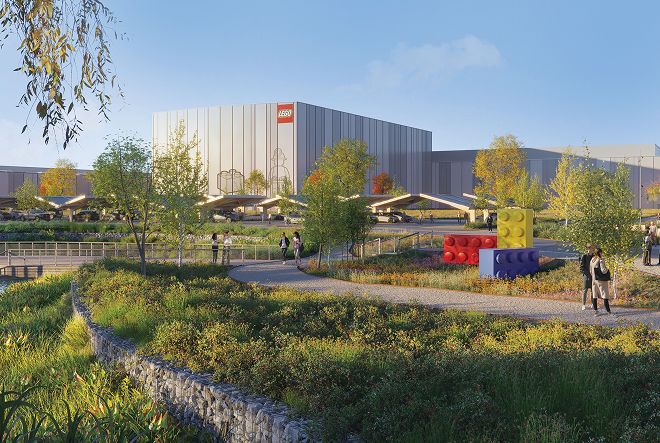
- The site is designed to be a carbon-neutral facility, aiming for LEED Gold or Platinum certification. It will be powered by an on-site solar plant featuring approximately 60,000 panels capable of generating 30–35 megawatts of energy.
A one-of-a-kind facility, powered by its own solar farm
The LEGO Group’s new manufacturing facility in Chesterfield County is designed to support the company’s sustainability and growth ambitions.
The site will be the sixth international manufacturing facility for the Danish toy company. “The U.S. is a growing market for the LEGO Group,” said Cecilia Fernandez, LEGO’s Virginia-based sustainability construction manager. With the new facility, “We can produce closer to where we’re actually selling the products. We see it as a win-win.”
The company plans to invest more than $1 billion to construct the carbon-neutral plant in Meadowville Technology Park. The 1.7-million-sq.-ft. precision manufacturing facility will be powered by its own 85-acre, 30-35 megawatt solar farm and create more than 1,760 new jobs for the Greater Richmond area.
Sustainability Is Key to Selecting Virginia
Virginia’s commitment to renewable energy and sustainability was a major factor in the LEGO Group’s selection of the Meadowville site.
As CEO Niels B. Christiansen said at the announcement, “We were impressed with all Virginia has to offer, from access to a skilled workforce, support for high-quality manufacturers, and great transport links. We appreciate support for our ambition to build a carbon-neutral-run facility.”
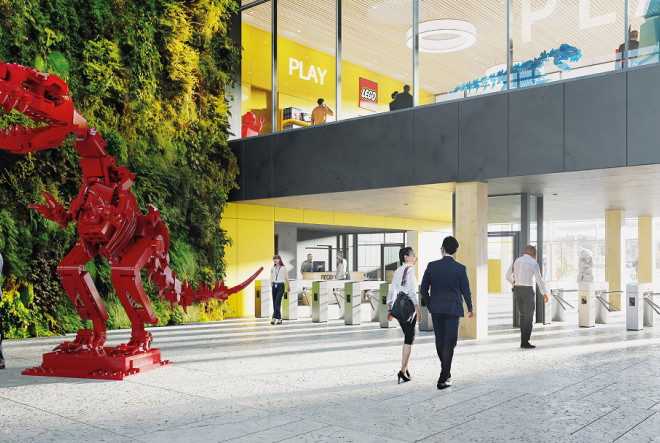
Sustainability begins with construction. Concrete, steel, glass, drywall — all of the material selections will focus on lowering the carbon footprint, such as by using recycled content whenever possible, Fernandez said. In addition, the entire office building, where site administrators will work, will be made from engineered mass timber — thick, compressed layers of wood that match the high-strength ratings of concrete and steel, but are lighter weight and significantly less carbon-intensive than those materials.
“Our early calculations show that we can save up to 40% of the carbon embedded in the building by using mass timber versus using ordinary concrete or steel,” Fernandez said.
The company plans to use wood from areas close to Virginia in the mass timber, from species native to the area. The wood will also be certified by the Forest Stewardship Council, which confirms that the wood was harvested sustainably in a way that protects fragile ecosystems, respects native cultures and economies, and does not decimate forests.
Creating an Optimal Environment for Producing LEGO Bricks
“What we plan to do, and it’s part of our LEGO ambition, is to first reduce the amount of energy that our buildings need,” said Cecilia Fernandez, LEGO’s Virginia-based sustainability construction manager. “So we try to make our production lines and our buildings run in a much more efficient way. What we can’t reduce, we compensate for with renewable energy.”
The buildings will be constructed for optimum energy efficiency, with features such as:
- Increased insulation to retain heat in the winter and cool air in the summer
- Automated building monitoring systems to control temperature and report electricity usage
- Sensors that detect when a room is empty and will subsequently switch off lights and adjust heating and cooling systems where possible.
Monitors in the factory will also track humidity levels, which is critical for LEGO’s new packaging materials. After years of packing LEGO bricks in plastic bags, the company has committed to phasing out single-use plastic packaging. At the Richmond plant, this means producing paper-based bags to hold the play bricks. But these materials are delicate and vulnerable to humidity changes, Fernandez said, so the monitors will make sure certain buildings maintain an optimum humidity at all times.
Sustainability, Wellness Goals That Set a Higher Bar
The LEGO Group is centering its lofty sustainability and wellness goals at the heart of the project - working with the Virginia landscape and resources to care for people and place. They are aiming to:
- Secure the highest green-building certification possible – LEED Platinum or LEED Gold – that would rate the project’s efficacy in reducing contribution to climate change, enhancing human health, impacting water resources, affecting biodiversity, relating to the green economy and affecting community and natural resources. LEED Platinum – a certification designed primarily for office or residential buildings – is a lofty goal for manufacturing operations, but LEGO’s set their sights nonetheless.
- Achieve a WELL certification — which assesses the health and wellness of people who work at the plant — for the project. This means features like a central staircase that entices employees to take the stairs rather than use an elevator, lots of indoor plants to foster employee well-being, and healthy food offerings.
- Include landscaping that protects and restore the natural habitat.
- Design the facility to be water-neutral, meaning rainwater falling on the site will be captured as much as possible and used for everything except human consumption.
- Send zero waste to the landfill by partnering with various sub-suppliers who can either use or properly dispose of the waste.
Engaging Virginia’s Talent Accelerator for Recruitment and Training
To build a sustainable workforce, the company engaged the Virginia Talent Accelerator Program (VTAP), a workforce initiative created by VEDP in collaboration with higher education partners. The program is designed to accelerate new facility startups by providing recruitment and training services fully customized to a company’s unique products, processes, equipment, standards, and culture. In 2026, Business Facilities named the program the No. 1 customized workforce training program in the nation for the fourth consecutive year.
With the Talent Accelerator, VEDP provided the LEGO Group with:
- A customized recruitment website, which went live alongside the project announcement and drew more than 3,000 job candidates within 36 hours
- Fully produced recruiting and training videos
- Candidate screenings
- More than 2,600 hours of job-specific training for initial hires
“They’re starting to learn about the LEGO culture and values,” Fernandez said. “And they will actually then be the ones who will model and share those values to new employees at the permanent facility.”
The Talent Accelerator will work in collaboration with Brightpoint Community College and the Community College Workforce Alliance to continue job-specific training through the opening of the permanent facility.
The LEGO Group in Chesterfield by the numbers
estimated new jobs in The LEGO Group's Chesterfield plant
capital investment in the Chesterfield facility
square footage in the Chesterfield facility
hours of job-specific training provided by the Virginia Talent Accelerator Program
Timeline
The LEGO Group's grand ambitions for lower emissions
LEGO and VEDP have been partnering not just to build a one-of-a-kind, carbon-neutral facility, but to make sure the local workforce is equally sustainable through the Virginia Talent Accelerator Program
LEGO announces it will build a $1B facility in Chesterfield County.
Virginia Talent Accelerator Program recruitment website attracts 3,000+ candidates in 36 hours
Official groundbreaking held at the Meadowville Technology Park site
Opening of a temporary facility to begin operations and training
Continued construction and installation of the on-site solar plant
Scheduled opening of the 1.7M-sq.-ft., carbon-neutral facility.
Meet your
industry partners

Sneha’s extensive experience in regulatory and compliance roles, as well as eight valuable years in the public sector, give her an insightful edge when developing strategies to grow employment across Virginia in manufacturing industries, including advanced materials, food & beverage manufacturing, and biopharmaceuticals.

Antje advises international companies on how best to expand operations into the U.S. in general and Virginia in particular, providing expert guidance on key topics, from site selection to tax incentives. She oversees VEDP’s offices in Europe, Korea, Japan, and Taiwan.