
Advancing the Mission
Virginia training ecosystem supports aerospace and defense growth
The U.S. Navy’s Submarine Industrial Base (SIB) Program Office has been tasked with working toward delivery of one Columbia-class submarine and two Virginia-class submarines each year. Meeting this demand, while sustaining its fleet currently in service, means working at five times the 2015 build rate a demand that will require an additional 140,000 skilled workers over the next decade.
Even at those numbers, the SIB’s work only touches on a fraction of the demand in Virginia for a skilled workforce capable of supporting aerospace, maritime, and defense projects. In August, the John F. Kennedy Ford-class aircraft carrier left the Newport News shipyard, while work continues on the USS Enterprise and Doris Miller. Meanwhile, the Navy is connecting with Virginia manufacturers on the feasibility of developing unmanned waterborne vehicles and other experimental technologies. This work is fueling the demand for essential skill sets such as welding, as well as more specialized expertise in engineering, robotics, and advanced manufacturing.
This demand is being met through innovative workforce pipelines that stretch across southern Virginia, from Hampton Roads to Danville.
Building an Advanced Manufacturing Workforce
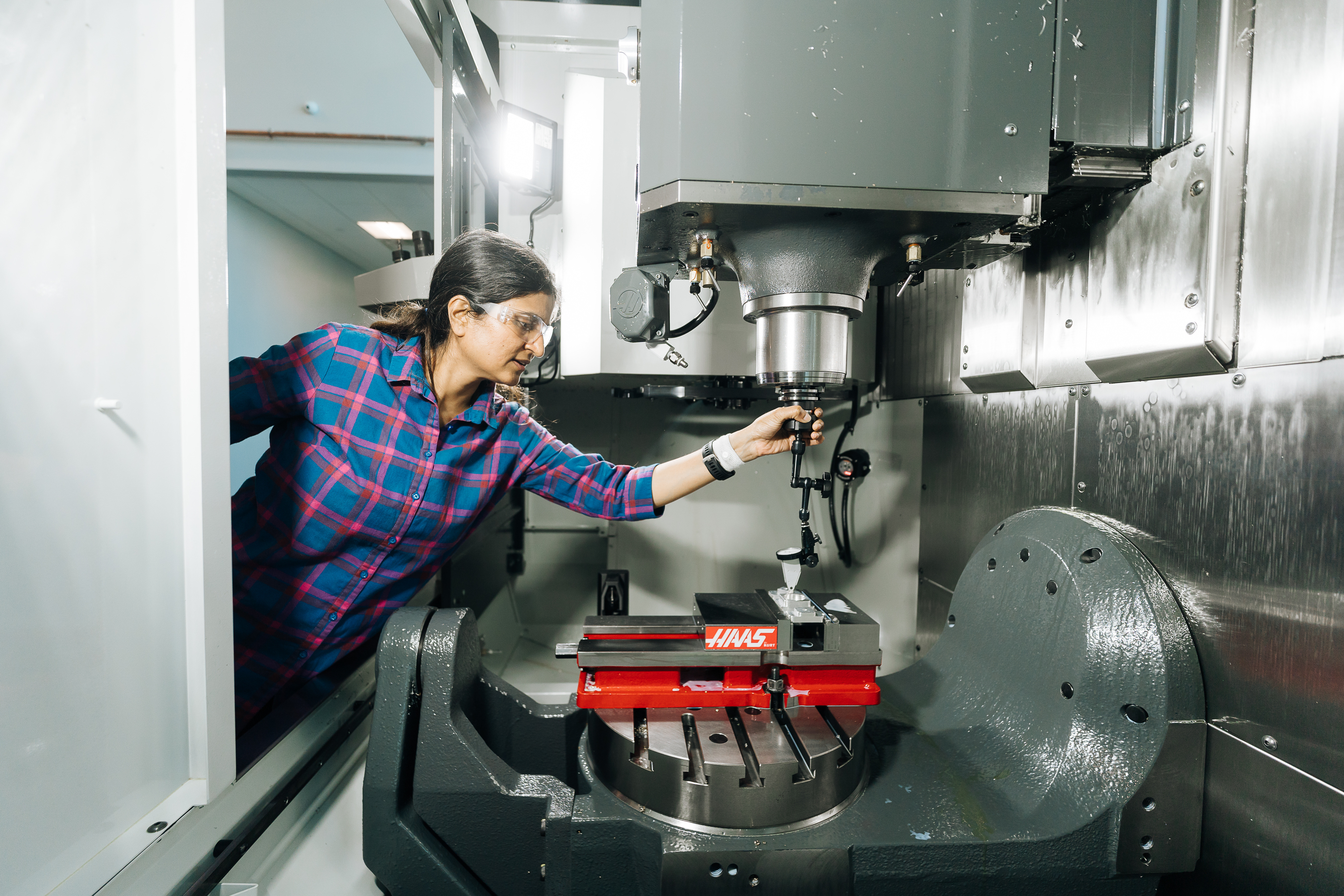
More than 200 miles from the nearest ocean, Danville may seem an unlikely source of maritime expertise, but it’s a specialization that has been years in the making. More than 20 years ago, the region began building the infrastructure to create a skilled trade and manufacturing workforce pipeline, preparing the resources that would attract new industries to the rural area.
“This idea that you invest in talent development and workforce development in people was a very intentional and deliberate strategy,” said Telly Tucker, president of the Danville-based Institute for Advanced Learning and Research (IALR). IALR’s investment began with helping to elevate what was already a solid, robust legacy talent pipeline for the advanced manufacturing industry and relevant sectors, thanks to a regional approach fueled by various partnerships.
The result was the extension of career and technical education high school and community college programs to include advanced third-year integrated machining and technology training and, later, the growth of the Great Opportunities in Technology and Engineering Careers (GO TEC) program. GO TEC was developed in Danville and Pittsylvania County to introduce middle school students to skills such as welding, CNC manufacturing, additive manufacturing, automation and robotics, among others.
Administered by IALR, its success has spread across the Commonwealth and into high school programs. During the expansion of Southern Virginia’s regional progressive workforce training model, the U.S. Department of War’s Industrial Base Analysis and Sustainment Office took notice.
With federal support, the IALR developed the Accelerated Training in Defense Manufacturing (ATDM) program to help the Navy reach its intense workforce needs. The ATDM pilot was designed to arm trainees, over the course of a 16-week program, with fundamental skills that allow them to walk into a defense manufacturing company and contribute on Day One. It does this through small class sizes with a one-to-one equipment-to-student ratio over 600 intensive hours of focused training. Students can graduate from tracks with multiple certifications.
“Our goal is to reduce the time to talent,” Tucker said. “Companies have told us we’ve saved them as much as two years [in training].”
The program’s goal is to matriculate up to 1,000 students each year and serve as a model for additional programs across the country that will help the Navy reach its total workforce needs.
We’re hearing from employers that being able to demonstrate credentials and competencies is becoming as important as the degree. This is especially important in newer technologies like drones and autonomous systems.
Chris Carter
Director, Virginia Space Grant Consortium
A National Center for the Maritime Industry
The Hampton Roads Workforce Council (HRWC) in Norfolk is among the organizations helping coordinate these programs through the Hampton Roads Maritime Training System. The system is essential in bringing skill sets together to produce defense assets in what Shawn Avery, the council’s president and CEO, calls the nation’s military metro. He adds that Hampton Roads has the largest concentration of shipbuilding and ship repair in the nation here with Newport News Shipbuilding and all of our repair yards.
With investment support from the Navy and the SIB Program Office, as well as other state and federal agencies, the Maritime Training System is connecting trainees from more than 35 regional programs, like IALR’s ATDM, to jobs in the defense sector. The organization works with 10 community colleges on credit and noncredit maritime training.
“We’re five years into this and producing about 5,000 to 6,000 people per year in this effort,” Avery said. “Within the next two to three years, we will have the capacity to produce up to 10,000 people per year in the maritime industrial base here in Hampton Roads. This will not only meet the current needs of our industry sector, but also any future economic development growth within the maritime industry.”
The greatest demand has been for employees skilled in welding, electrical work, pipe fitting, ship fitting, and machining. Among other areas, the HRWC has aggressively expanded welding training, moving from meeting just 50% of demand five years ago to having one qualified welder for every open position today.
The HRWC is just part of a robust maritime training ecosystem in Hampton Roads, the epicenter of the largest shipbuilding industry in the United States. The Apprentice School in Newport News has been training shipbuilders for Newport News Shipbuilding (NNS), a division of HII, since 1919.
At IALR, Tucker noted that welding remains the most popular program in the ADTM track. However, he’s watching the Navy’s increased interest in nondestructive testing (NDT). IALR is also exploring adding a track around electronics. “That is in high demand in the shipbuilding field and in the Navy, both for submarines and surface ships,” Tucker said.
Enhancing that demand is the trilateral AUKUS partnership between the United States, Australia, and the United Kingdom, a security agreement to create cohesion in nuclear arsenals among the allies that includes the Royal Australian Navy’s purchase of five Virginia-class submarines from the United States. NNS, Virginia’s largest industrial employer, is a member of the AUKUS Workforce Alliance, a partnership with three Australian universities dedicated to building a skilled workforce to support the partnership. The College of William & Mary will serve as the U.S. academic home of the partnership.
Focus on Aerospace Excellence
The defense sector’s interests also extend into aerospace applications and this demand is being met in Virginia as well.
According to preliminary results from a statewide aerospace workforce needs study conducted by the Virginia Space Grant Consortium (VSGC) in partnership with the Virginia Aviation Business Association, 68% of surveyed aerospace companies and suppliers expect workforce demand to increase over the next one to three years. That demand is focused on software and aerospace engineering, as well as technicians for engineering and unmanned aircraft systems. Employers are looking for technical expertise and specialized skill sets that organizations like VSGC are poised to deliver.
“We work at all levels of the workforce pipeline,” said Chris Carter, director of the VSGC.
For high school students, the VSGC hosts several free NASA academies, including the Virginia Aerospace Science and Technology Scholars and the Virginia Earth Systems Science Scholars, which can lead to a spot at a one-week residential, work-based learning experience at NASA’s Langley Research Center in Hampton. The Virginia Space Coast Scholars can lead to a one-week academy at NASA Wallops Flight Facility for high-performing students in the online course.
“It’s a pretty intense work-based learning experience for these students to be immersed in all things NASA on site,” Carter said. Students bolster technical skills as they collaborate to plan a human mission to Mars, while also learning soft skills around collaboration and communication.
At the university level, students at VSGC member institutions Hampton University, Old Dominion University, the University of Virginia, Virginia Tech, and William & Mary are eligible for research scholarships and fellowship programs. The VSGC also has strong partnerships with the Virginia Community College System and its 23 constituent colleges. “We place about 150 students a year in paid internships with business and industry,” Carter said. All told, programs like those available through VSCG have helped prepare as many as 75,000 Virginia workers to serve in core occupations for the aerospace and unmanned systems industries.
Even for graduates of higher-education institutions, hands-on training is becoming an essential differentiator. In fact, the VSGC aerospace survey sees “applied workforce development” – including internships, apprenticeships, hands-on training, and industry-embedded education – as the most important workforce opportunity today.
“We’re hearing from employers that being able to demonstrate credentials and competencies is becoming as important as the degree,” Carter said. “This is especially important in newer technologies like drones and autonomous systems. This is why we are investing heavily in adding programs to prepare the future skilled technical workforce.”
At one time, it may have been difficult for individuals to demonstrate experience in designing, building, and maintaining bleeding-edge aerospace and defense systems. Not anymore. Virginia’s range of hands-on training opportunities are preparing individuals at every level for rewarding careers advancing innovative technology and the defense mission.