One Industry’s Property Landline
Localities and airport officials are helping promising development sites gain greater visibility — and optimal occupants
Business is booming in the U.S. aerospace and defense industry, which generated economic output of $500 billion in 2025, according to Aerospace Industries Association data.
In Virginia, the sector supplied a sizable $757 million in state and local tax contributions and more than $12 billion in economic value.
Anticipating continued aerospace and defense-related demand and growth, a number of regional, local, and other agencies in the Commonwealth are collectively working to inform industry members about available sites that could accommodate their operations — including airport and maritime properties with advantageous customization capabilities and infrastructure.
Advocating for Patriot Power Park
Patriot Power Park is an 850-acre industrially zoned waterfront property on the York River in York County. Situated between a U.S. Coast Guard training center, Joint Base Langley-Eustis, and other military and defense assets, the location allows employers to draw from a talent pool of active duty military personnel, and graduates from 12 area colleges and universities, bolstered by a robust regional workforce training ecosystem in the defense and maritime industries.
The site is outfitted with utility connections from Dominion Energy with two 60-megawatt transformers, a million-gallon-per-day-capacity on-site water treatment plant with robust municipal water and sewer capacity, rail access, and a pier. A channel depth of 40–50 feet provides seamless maritime access with no bridges or overhead obstructions to the Atlantic Ocean.
The waterfront megasite can be a tremendous opportunity for a company that’s interested in activating a working waterfront, according to Hampton Roads Alliance COO Steve Harrison.
The shipbuilding and defense industries “are growing exponentially in this new economy that’s looking at remilitarization, reshoring and reindustrialization,” he said. “This site fits [those] needs really well.”
Interest in Patriot Power Park has escalated since its listing was shared publicly this summer; however, the site’s owner remains committed to finding a buyer who will strategically align with regional and state development goals, said Darren Williams, deputy director of the York County Economic Development Authority.
The owner “has been looking for a user that’s fortuitous but also fits the community,” he said. “You don’t see that all the time with private property. This has been a real partnership.”
Advancing AirCommerce Park
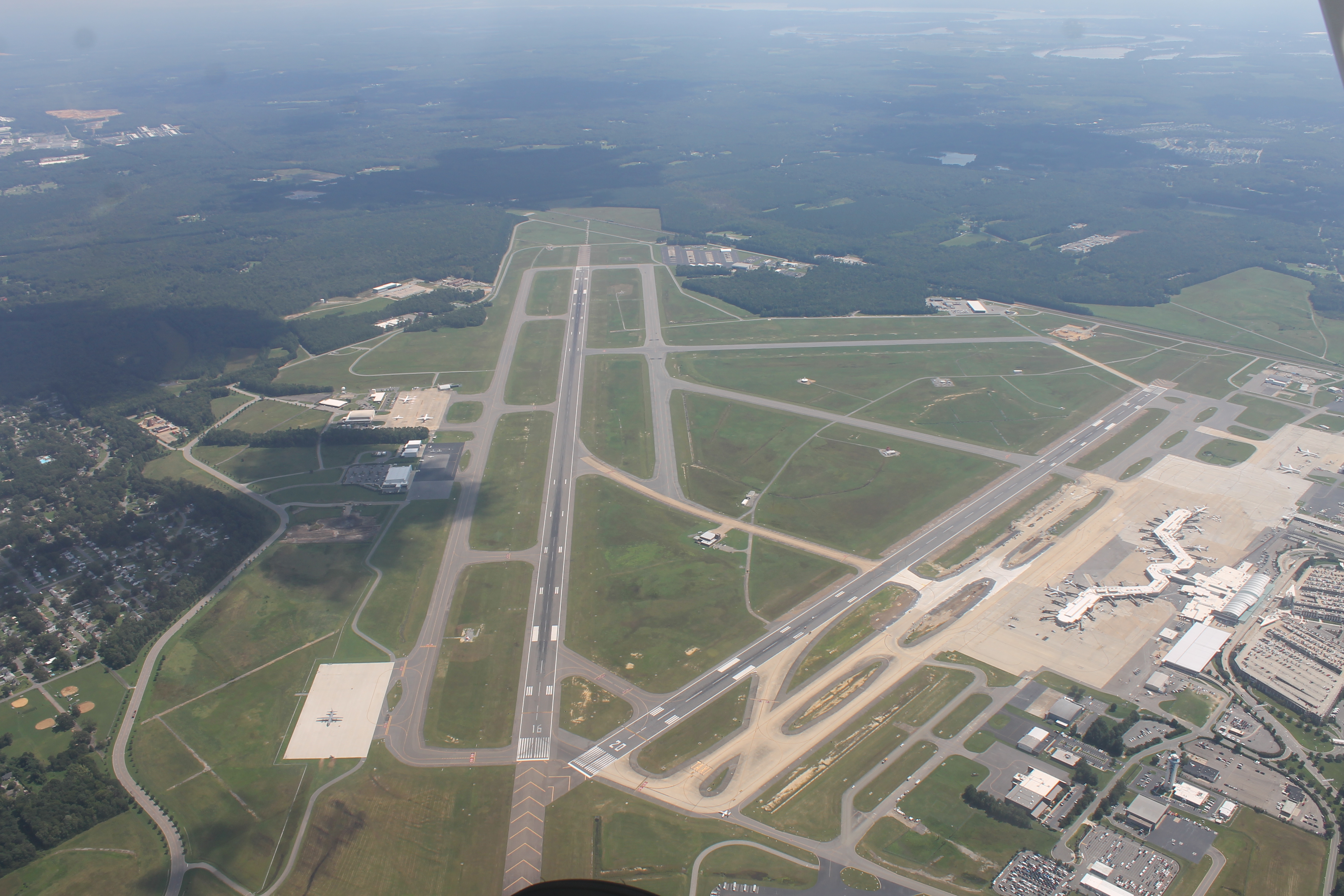
Newport News/Williamsburg International Airport (PHF) is conveniently situated near federal research facilities, including NASA’s Langley Research Center and the Jefferson Laboratory, with roundtrip Amtrak service to Richmond, Washington, D.C., and points north. Its amenities include an FAA-controlled tower and airport hangars with a number of aerospace and defense tenants, according to Chris Morello, the airport’s executive director.
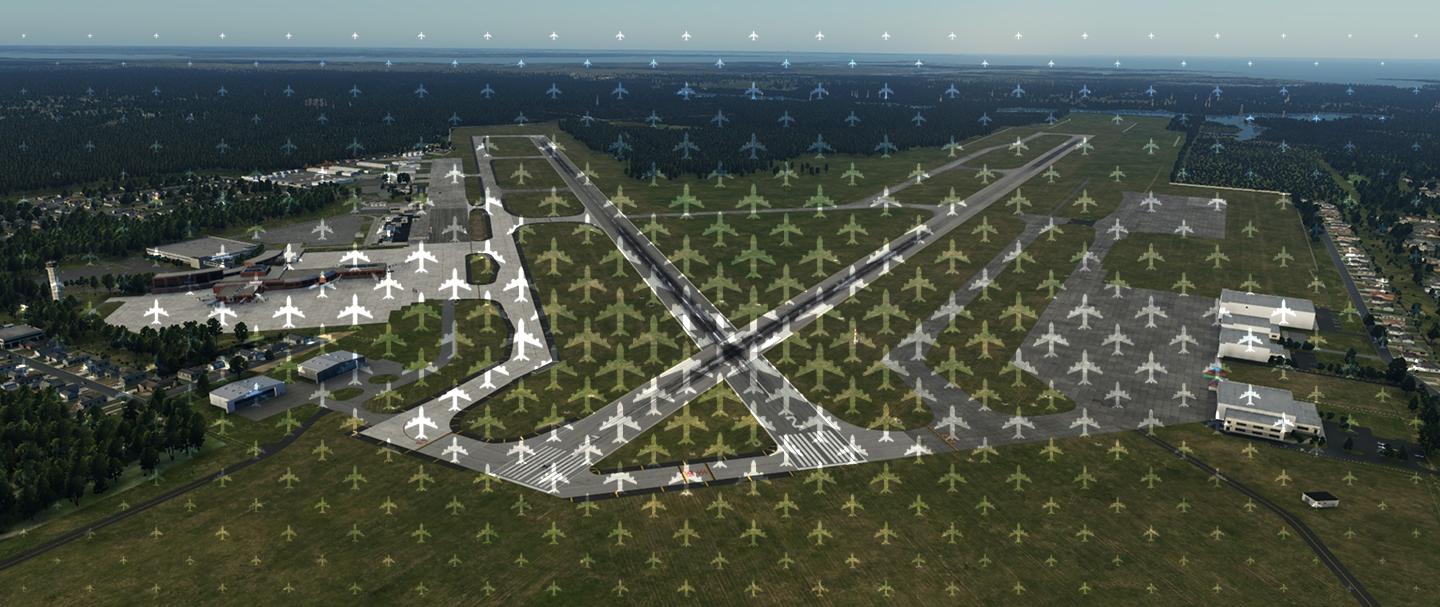
The campus also includes two sections of land with access to runways of 8,003 feet and 6,526 feet, zoned for industrial use such as aircraft manufacturing, which the airport is holistically promoting as AirCommerce Park. The airport’s draft master plan update includes plans to extend the former to an even 10,000 feet.
A 280-acre parcel on its west side features 230 acres immediately available for development, while a 50-acre site is graded and ready for a user. Both sites have robust utility capacity.
The airport plans to help strengthen area talent pool resources by providing space and other assistance to the Hampton Roads Mobility Innovation Center, an emerging aviation sector workforce training and platform testing initiative that received more than $3 million in Commonwealth grant funding in April.
“We’re not just expanding our aviation capabilities. We’re building the skilled workforce that will draw aviation and aerospace companies to AirCommerce Park and help them thrive,” Morello said.
Multiple studies, conducted with support from VEDP’s Virginia Business Ready Sites Program (VBRSP), have helped the airport analyze its properties’ topography, environmental conditions, and other site considerations, providing critical due diligence to support future development and investment decisions. The VBRSP identifies, assesses, and improves industrial sites, with a focus on larger industrial sites that can make a regional impact. A related program, the Virginia Business Ready Expedited Permitting Program, was established in 2024 to expedite the permitting process for certain economic development projects and sites.
Prepared sites — in many cases with gas, water, and sewer lines already built in — speed up the site selection process, reduce risk for companies, and make the process of relocating to, or expanding within, Virginia as smooth as possible. Potential investors seek a pro-business environment with certainty regarding permitting, utilities, and infrastructure, all of which reduce risk and enhance speed to market.
PHF is now fielding large-scale and other development inquiries — and can effectively provide prospective companies with clear guidance on incentives, development requirements, and other critical considerations.
“Companies don’t want to wait around for answers,” Morello said. “We’re getting large-scale inquiries now, and we can give them clear guidance on the site, incentives, and development requirements right away.”
Companies don’t want to wait around for answers. We’re getting large-scale inquiries now, and we can give them clear guidance on the site, incentives, and development requirements right away.
Chris MorelloExecutive Director, Newport News/Williamsburg International Airport
Enhancing Richmond International Airport
Richmond International Airport had been updating an approximately 60-acre parcel of land to boost its leasing appeal when an additional 200 acres southeast of the airport became available during the COVID-19 pandemic.
Located less than 10 miles from downtown Richmond and 100 miles south of Washington, D.C., near The Port of Virginia’s Richmond Marine Terminal and several major interstate arteries, and a few hours from the port’s Norfolk-area terminals, both sites are zoned for industrial use and airport infrastructure access, including runways of 9,003 and 6,607 feet.
Utilizing a $1 million VBRSP grant, the airport is working with the Henrico Economic Development Authority to augment and promote the 200-acre offering to possible tenants.
“These are some of our top sites in the county for economic development projects, specifically aerospace and aviation,” said Henrico EDA Managing Director Andrew Larsen. “From an industrial real estate perspective, there’s not a whole lot out there where you don’t have a developer that controls it or shareholders. It’s a unique situation.”
To allow schools to partner with startups and investors for hands-on learning and creation, the airport and development authority hope to establish an airport innovation center in the future, as well as an aviation-related workforce development program.
“Whether it’s at the high school or community college level, that leads to the ultimate success of any company locating here,” Larsen said. “For these companies, that is an absolutely necessary thing, so we’ve begun to try to lay the groundwork.”
The airport has applied for additional funding to produce water and sewer designs and plans to relocate a road on its property to expand the available acreage with direct runway access.
“We see the airport [as] an economic engine for this region,” said Richmond International Airport Chief Growth Officer Martin Rubinstein. “You [typically] don’t walk into a county and say, ‘I need you to move a road’, but they’re willing to do that — and they have been willing to help get funding for the project because it makes sense for both the county and airport.”
Shovel-Ready Airport Sites in Winchester
Near the West Virginia border, Winchester Regional Airport gives businesses direct access to development-ready sites with runway access, talent, customers, and supply chains across the mid-Atlantic while providing the airspace freedom for test flights. In the past six years, the airport has made capital investments totaling approximately $45 million.
By aligning with state and federal partners and securing local funding, the airport was able to deliver major improvements, including a new terminal building, according to Winchester Regional Airport Authority Executive Director Nick Sabo.
Locating operations at the airport-owned site would provide access to a 5,500-ft. runway capable of accommodating the largest business jets on the market, close proximity to the Virginia Inland Port in Warren County with direct rail connections, rail access to Norfolk’s port facilities, and a reverse-commute advantage from Washington’s western suburbs. Equally important, the site offers uncontrolled airspace.
“It’s ideal for flight testing operations,” he said. “We’ve hosted those activities. You can do great flight testing here and not have to get caught up in some of the more congested airspace around Washington, D.C., yet still just 70 miles from FAA headquarters.”
To ensure the 30-acre property will be a profitable, low-risk investment for a company, the airport has performed tree removal, grading, and other notable preconstruction tasks, including an environmental assessment to fully comply with National Environmental Policy Act requirements for airport development. The property is also adjacent to relevant industrial development, notably One Logistics Park, an industrial park that offers an additional 150 acres to create a campus-like atmosphere with direct access to hangar operations, along with connectivity to Interstate 81 and the Virginia Inland Port.
“We have tried to go above and beyond to look at our site through the lens of a developer and understand some of the nuances of it being on airport property, as it relates to the requirements of the FAA and the Virginia Department of Aviation — moving through those steps so they don’t pose any new challenges to the client,” Sabo said. “That’s been a key to our success in getting attention from aerospace companies.”