Alexandria’s Light Bulb Moment
Beyond the Northern Virginia city’s picturesque street scenes and ideal location is a rapidly flourishing innovation scene that’s being revealed in real time
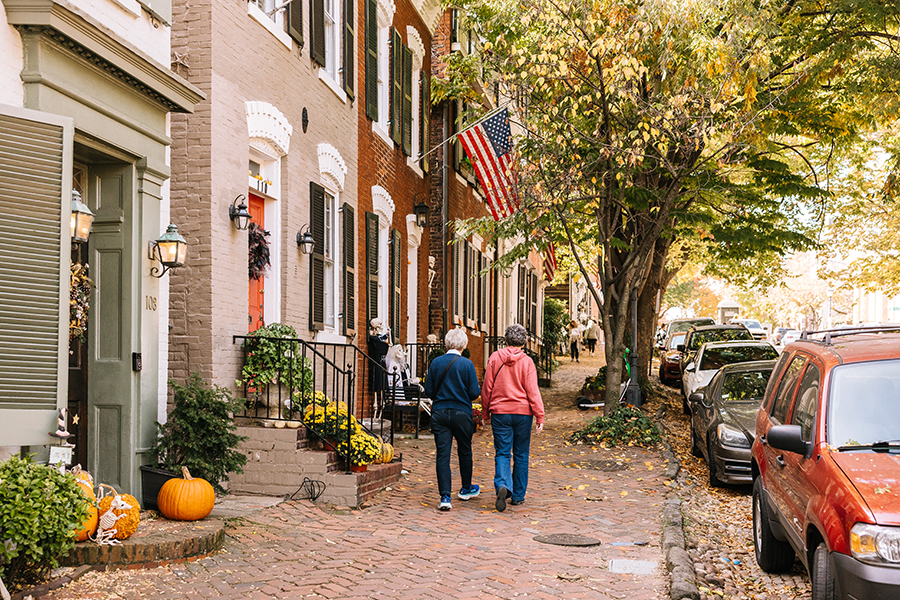
Alexandria is known for Old Town’s historic shops and homes that are as inviting as they are immaculately preserved.
But it’s also home to groundbreaking, game-changing technology, including Saltenna LLC’s capability to connect with wireless signals traveling across the surface of water, soil, and metal. And Aber Instruments’ ability to measure live cell concentration, a critical component of industries ranging from biopharma to brewing.
It’s not just history, but history-making innovation that’s the new draw for the Northern Virginia city established in 1749. From welcoming startups to students, Alexandria has been transforming into an ideation destination, complete with recognition by Business Facilities as one of the country’s top innovation hubs to watch.
And momentum is building.
“We are running hard to grow,” said Dendy Young, CEO of Saltenna, which pioneered the aforementioned technology of harnessing surface waves to send wireless signals where they’ve never been used before. The company now owns six patents and is launching two products to enable novel communication for everyone from scuba divers to oil and gas operations exploring the deepest recesses on Earth.
Towering Innovation
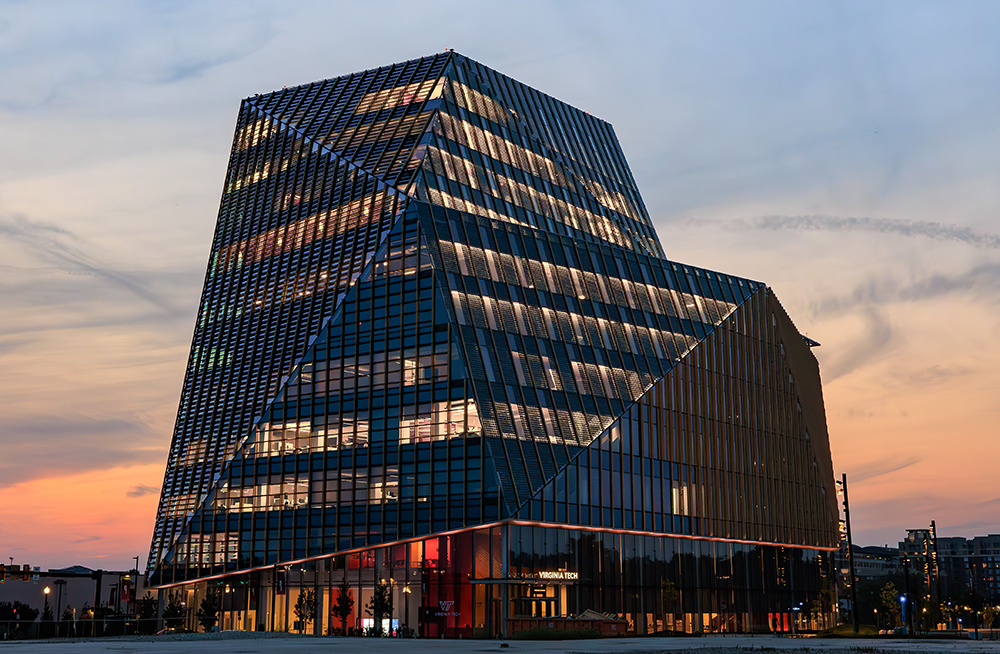
There’s perhaps no greater modern monument dedicated to innovation in Alexandria than Virginia Tech’s new academic building in Potomac Yard, part of the package that helped Northern Virginia land Amazon’s coveted HQ2 in 2018 with a focus on increasing the overall volume of tech talent in the Commonwealth.
Class has not only been in session since January 2025, but Academic Building One, an 11-story, 300,000-sq.-ft. edifice, is already buzzing with 450 enrolled graduate students. Virginia Tech branded its graduate and research-focused academic program as the Institute for Advanced Computing.
“We came with a purpose,” said Lance Collins, vice president of the Greater Washington, D.C., area for Virginia Tech. “I imagine we’re kicking off a new important tech district in the country.”
That belief stems from the ecosystem that Collins and Virginia Tech are building in and beyond Alexandria. At its heart, it’s about a more thoughtful approach to curriculum. Instead of simply wishing graduate students good luck when they earn their master’s degree in computer science or computer engineering, Virginia Tech has added a more immersive requisite experience — a group project built on teamwork and collaborating with an outside organization.
“They’re complex, they’re real-world,” Collins said of the projects. And they could involve everything from partnering with Alexandria workforce optimization startup MARi to create an agentic AI tool to transform course materials to working with the Secret Service to elevate drone detection and disablement. Ultimately, the projects often extend to enduring relationships between the companies and the institute — as well as a talent pipeline.
“We’re an academic institution born out of economic development,” Collins said. “And we take that seriously.”
Coming Together
Dominoes are falling into place across Alexandria, which already benefits from built-in advantages such as proximity to three international airports, a highly educated workforce, and numerous federal institutions nearby.
In November 2025, the National Science Foundation announced its relocation to the U.S. Patent and Trademark Office’s campus. Additionally, the U.S. Department of Housing and Urban Development shared that it would move into the National Science Foundation building in Alexandria’s Carlyle neighborhood — joining burger chain Five Guys Enterprises, LLC and financial publication The Motley Fool, both of which are headquartered there. And in September, national security company Systems Planning & Analysis announced its purchase of a new headquarters that would be home to 500 new high-earning workers. With Amazon, Boeing, and the Pentagon just north in Arlington County, and additional federal agencies scattered about, the critical mass needed for an innovation revolution has arrived.
Having a federal agency as a neighbor is really important when you’re able to show up and have actual face time with your clients.
MARIAN MARQUEZ
Senior Vice President, Alexandria Economic Development Partnership
Emerging companies like Saltenna and Aber Instruments boast a consistent profile among their peers. First, they’re not just software players, but increasingly possess physical tech — for example, drones delivering medication to hard-to-reach destinations. Second, they serve both private industry and federal agencies.
“Having a federal agency as a neighbor is really important when you’re able to show up and have actual face time with your clients,” said Marian Marquez, senior vice president at the Alexandria Economic Development Partnership (AEDP).
For example, at the same time Saltenna is serving recreational scuba divers, they’re also working with the U.S. Air Force, Army, Navy, U.S. Special Operations Command, and others.
“We’re using those relationships and that knowledge to take us forward,” Young said.
They’re doing the same with resources provided by the Virginia Innovation Partnership Corporation (VIPC), which has provided the company with meaningful introductions to investors and support organizations. Young said the collaboration has helped Saltenna answer the question, “How could we produce our product faster?”
And there’s room to grow for more startups and larger enterprises, including in the National Landing area rebranded for the arrival of Amazon’s HQ2, the southern portion of which resides in Alexandria, as well as other on-the-move areas with economic upside. A large group of partners, including AEDP, Amazon, Arlington County, VIPC, and Virginia Tech, are working to develop the National Innovation Quarter, or National IQ, an innovation hub spanning Alexandria and Arlington that brings together leaders from academia, industry, entrepreneurship, and government to accelerate technology solutions.
Building Momentum is an Alexandria manufacturing facility focused on prototyping, systems integration, and training, where Saltenna is making waves. The resources in that space are crucial to startup success and aren’t readily available in many localities on the East Coast. An innovation lab led by a team experienced in challenging environments such as battlefields and disaster zones, Building Momentum specializes in helping companies develop and field test prototypes to bring commercial tech to life.
“It’s a tremendous resource for the whole community,” Young said of Saltenna’s “ad hoc training facility.”
We’re an academic institution born out of economic development. And we take that seriously.
Lance Collins
Vice President, Greater Washington, D.C., Area, Virginia Tech
Similar maker spaces and industrial innovation labs are popping up across Alexandria, answering the call of a growing startup scene. That scene is why Alexandria recently launched Accelerate ALX, a program to equip up to 15 Alexandria-based growth-stage companies with the resources they need to be the next big thing in AI, quantum computing, robotics, aerospace, cybersecurity, defense, and other verticals.
A Focus on Long-Term Goals
Aber Instruments, the global company behind the aforementioned biomass measuring tech, arrived from the United Kingdom in 2024 to create its first U.S. outpost in Alexandria. The move was prompted by a desire to be closer to its customers.
“Whenever cells matter, we measure it,” said Dr. Aditya Bhat, president of Aber Instruments.
Of course, there’s more to it than simply using a scale or ruler. Aber Instruments developed and patented real-time biomass monitoring using radiofrequency impedance — no waiting, no guessing.
They’re also measuring workforce growth, something they manage carefully because of another innovation they bring to the lab: a 100% employee-owned company structure and the flourishing culture that follows.
“It prompts us to make better long-term decisions,” Bhat said of the setup, which is more prevalent across the pond than stateside.
Similar maker spaces and industrial innovation labs are popping up across Alexandria, answering the call of a growing startup scene. That scene is why Alexandria recently launched Accelerate ALX, a program to equip up to 15 Alexandria-based growth-stage companies with the resources they need to be the next big thing in AI, quantum computing, robotics, aerospace, cybersecurity, defense, and other verticals.
Building Bridges
Alexandria’s innovation is spanning once-disparate connections among people and places with impressive speed. From the shore to the depths of the ocean, with an assist from Saltenna. From research institutions to the workforce, and sometimes back again. From federal agencies to private industry, and often both.
And from Alexandria to Washington, a planned actual bridge spanning the Potomac River. The bridge, included in the $88-million Long Bridge Project, will include a 16-foot-wide path providing both pedestrians and cyclists a safe, scenic shortcut. Another highly anticipated bridge in nearby Arlington County, linking National Landing and Crystal City to Ronald Reagan National Airport — and known as the CC2DCA Multimodal Connection — will further connect the area’s innovation ecosystem.
The Amazon HQ2 project built bridges within Northern Virginia’s economic development ecosystem. It was the genesis for the Northern Virginia Economic Development Alliance, comprising Alexandria and seven neighboring jurisdictions.
Collins sees a bright future in the bridge that Alexandria and Virginia Tech are building, together.
“I think our location, combined with our mission, makes us a destination,” he said, contrasting the urban environment with traditional college towns. “A part of the education we’re offering is that you’re in the world. It’s the opposite of the ivory tower.”
And as more federal agencies, nonprofits, and companies including Amazon, Boeing, and Northrop Grumman partner with the school, that world only gets bigger.
“I think it’s an exciting place, and seeing our student growth, it suggests that so do they,” Collins said. “There’s laser-focused interest in growing the full tech ecosystem.”