
Disrupting Conventional Historical Wisdom
A Conversation With Christy Coleman
Christy Coleman is the executive director of the Jamestown-Yorktown Foundation, an educational Virginia state agency that offers programs and resources about early American history through its living history museums, Jamestown Settlement and the American Revolution Museum at Yorktown. VEDP Senior Vice President for Marketing, Communications & Research Stephen Hartka spoke with Coleman about what citizens and companies can take away from Virginia’s history as the Commonwealth celebrates the 250th anniversary of the United States’ founding.
Stephen Hartka: Can you give us an overview of the Jamestown-Yorktown Foundation and its place in Virginia’s historical preservation efforts?
Christy Coleman: The Jamestown- Yorktown Foundation got its start in the 1950s as Virginia was planning for the 350th anniversary of the arrival of the English. As a part of that, the Virginia legislature created Jamestown Festival Park as a celebratory space. It was also a response to federal actions on Jamestown Island, the actual site. They were doing archaeological work there, putting up statuary, and things like that. It was a commemorative space that Festival Park occupied. In the late 1980s and ‘90s, the institution transitioned from just being a commemorative space to an actual museum.
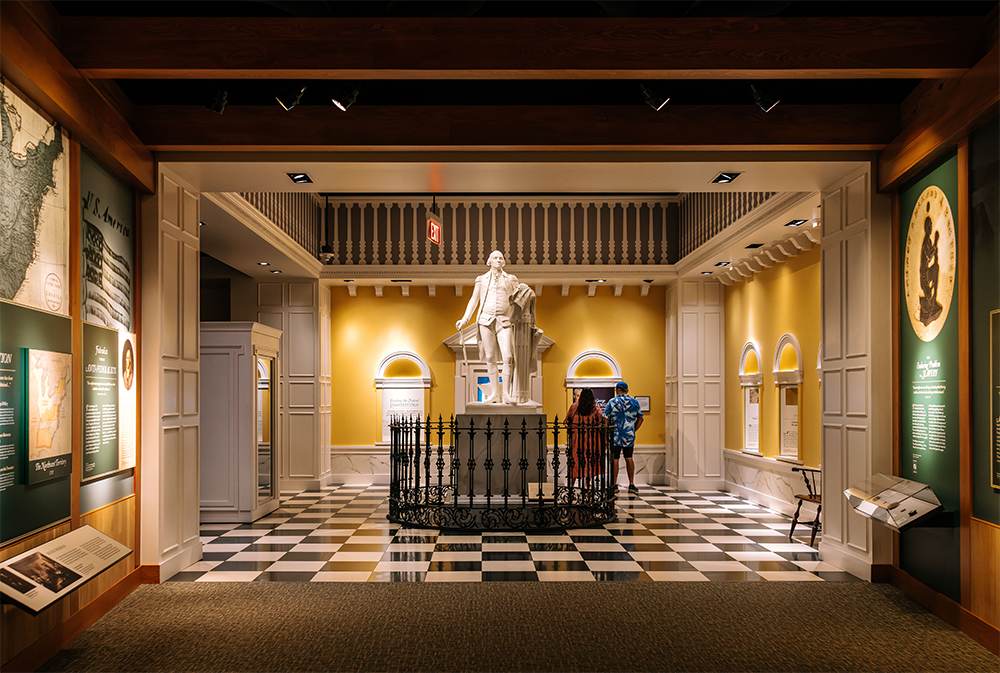
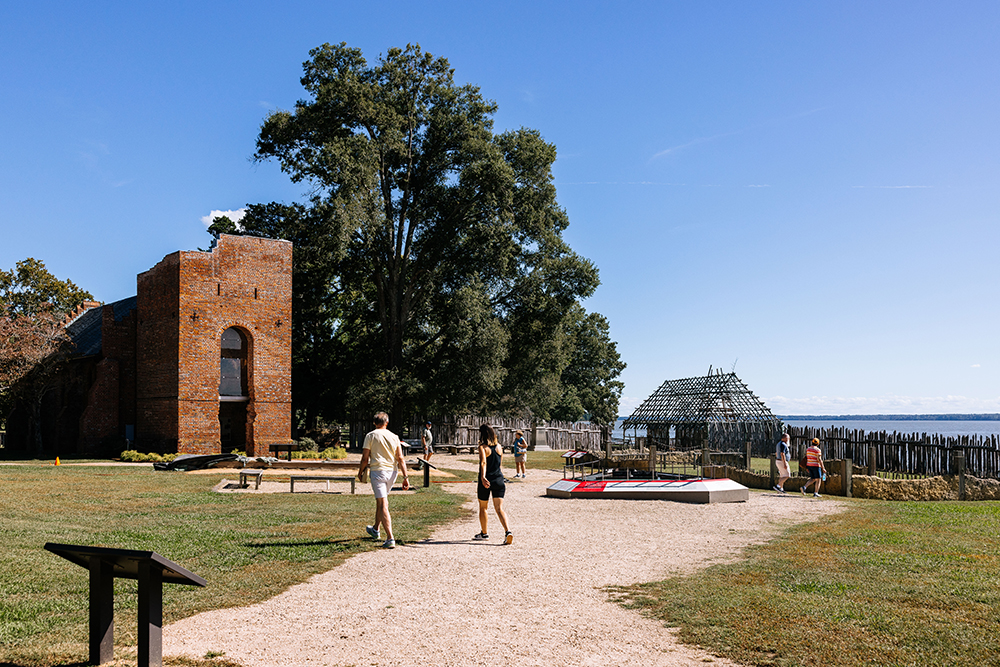
Today, we have the Jamestown-Yorktown Foundation, whose mission is to explore the convergence of cultures and legacies bequeathed to the nation. We look at the settlement era, the nation’s founding era, and the connections between them. We do that through exhibitions, public programs, guest lectures, living history, and galleries. We have a really extraordinary operation, and over 400,000 visitors come through every year.
Hartka: I’ve enjoyed getting to know your career in preparing for this. You’ve been known for disrupting how institutions tell the story of America’s best, and that has entailed pushing for fuller, sometimes uncomfortable, narratives. Coming from the business realm, where disruption often means simplifying things or making them easier, your version of disruption has looked a little different. It’s often made things more complex, not less. Why is that important, and how do you lead through that kind of complexity?
Coleman: I just want to know how things work. Why communities are the way they are. How did they evolve, how do they interact? When do they come into conflict and why? While it’s much easier to create simplified narratives of the American past, it doesn’t explain national moments of disruption where change and expansion of what it means to be an American take place. It’s not brought about out of the goodness of somebody’s heart, but because people at different stages and places challenge the nation to be better, to live up to her creed.
Let’s take a look at what that means. Let’s try to figure out what it means to be an American in all of its facets, and why we progress, contract, progress again, and contract. Each time we go through that cycle, the nation is never the same again, which is a good thing in my view. I don’t disrupt to disrupt. I often struggle with that descriptor. Instead, what I work hard to do is to help people understand that who we are as a country has always been in flux. It’s always been a multiplicity of voices, backgrounds, and resources that have worked to define what America is.
I’m of the great belief that America’s strength is that it’s always had multiplicity, and finding moments of common ground and agreement. We’re a nation literally born out of a protest, a series of disagreements, and an idea — a core idea that effective government is one that has the consent of the governed, that’s responsive and reflective of their needs, that lives up to its creed.
My job in the museum space deals with what that evolution looks like on the ground. Who are the people and places who make that happen? I love history in all these extraordinary facets because it’s always the story of us. It isn’t the story of those guys over there; it’s literally the story of us. You can’t have us if you’re not including us, right? And I mean “us” in the collective of all the different peoples who have rightfully claimed themselves to be Americans.
Hartka: You’re now leading a state affiliated institution representing a complex history, and talking a bit about the history of the organization itself. I’m sure you interact with a wide range of stakeholders. What have you learned about driving change in that complex environment, and what lessons from that experience might you have to offer to other public- or private-sector leaders?
Coleman: This is about leadership style, too. There are people, unfortunately, who are still of the mindset, “My way or the highway.” To me, you have to build a shared vision. I’m fortunate that I came to work for an organization that, out of the gate, said, “We are nonpartisan. We will let the history lead us.” That’s made all the difference in the world.
I have three boards — one that’s fundraising, one for enterprise, and one for governance, which is led by political appointees as well as legislators and people in administration. I have a staff of 300-plus people. Each of them comes to their work with a passion and a desire to grow and learn, both professionally and otherwise. An adaptive leadership style allows me to really listen. But as the appointed executive director, it’s also my job to develop that shared vision, because once you share the vision, you can do the remarkable.
Hartka: In the economic development space, we sometimes hear Jamestown Settlement described as an early startup, a high-risk venture backed by investors. From your perspective as a historian, how useful is that analogy? Is it revealing or obscuring different facets of this history? Does this framing have any lessons to offer us?
Coleman: I think that framing is accurate. People purchased stock in the Virginia Company and got workers interested in coming over and developing this colony. The purpose was to make money. It was a startup, as were all 13 of the colonies. Each were startups to either solve a particular problem or to expand the Crown’s interests in the new world.
[Virginia] was a startup, as were all 13 of the colonies. Each were startups to either solve a particular problem or to expand the Crown’s interests in the new world.
Christy Coleman
Executive Director, Jamestown-Yorktown Foundation
The fallacy is that our nation was founded for religious freedom. That’s not accurate. The nation was founded to make money for the Crown, to build an empire. Each of the colonies developed a particular character, for lack of a better term. Pennsylvania became the open place — religious tolerance was key because they had so many different people. Maryland became a safe haven for Catholics in an Anglican world. The Puritans, deemed a radical cultish expansion, were put toward Massachusetts, and so forth.
The Crown was very concerned about expansion of Catholicism in the West. “Oh, we’ve got to stop the Catholics and the power of the Pope.” But if you were to ask the average person, that’s not how they were taught the history of America. But the forensic evidence is very clear about what actually was happening at the time.
The question we need to ask ourselves is, “If the forensic evidence from the period tells us this one thing, how did we develop a different storytelling narrative around it?” That’s something else that started to develop when these 13 colonies decided to unite. They had to figure out a common narrative about the origins of the nation. “A nation born of protest” isn’t necessarily the way they wanted to frame it. Over time, different things have evolved in that storytelling.
Hartka: The 250th anniversary will put places like Jamestown and Yorktown in the national spotlight. If we treat this moment not just as a commemoration, but as a strategic moment, what would you want Virginia’s business, legislative, and economic development leaders to do differently because of what they’ve learned from this history?
Coleman: That’s an interesting question. I’m in the education space, the “driven by a mission” space. Business communities are driven by their bottom lines and their profits. They’re driven by the products or inventions they make that they want to get into the hands of the public, so they’re building a different relationship with the community. They want an environment friendly to their needs.
I would say that business also has a responsibility for protection of the republic, to the ideals laid out 250 years ago. Because without the ideals, they will find themselves in similar situations faced by the King and the Crown and those early companies. They will have vastly unhappy populations who say, “This government, this job, doesn’t have my best interest at heart anymore.”
I think we sometimes trick ourselves. Part of the reason why we have lost so much from the American middle class was the shift toward shareholder value over expansion, which brought about strong wages and built demand. When people have money, you build demand. They’ve got it in a place now where I don’t think that’s happening.
People are getting squeezed out. They’re not invested in the same way. We see that in people’s lessening loyalties to their companies, in their inability to even do something as basic as the family vacation. If we don’t embrace the creed, for lack of better phrasing, my concern is that we’ll find ourselves at a point of no return, where people are no longer interested in finding common ground or supporting the common good. We’re not in an era of the common good anymore.
For me, the 250th has become far more reflective, even though I work with this history every day. On a personal level, it’s about what it all meant because those 56 men who sat in that room in Philadelphia during that hot summer even stated in the Declaration that they were willing to sacrifice for this grand idea — their fortunes, their lives, but they weren’t going to give up their sacred honor. They thought, “This is what being honorable is about — to stand for something, no matter what you may lose.” I think the idea of America is something worth fighting for.
Hartka: What lessons might translate to leaders trying to modernize complex organizations today?
Coleman: I’ve learned effective leadership requires watching, assessing, and most importantly, listening to staff and customer needs. Align what you’ve learned with the mission or purpose of the organization, chart a strategic direction, and find innovative ways to bring about the change needed. Communicate to all stakeholders with transparency.
Hartka: What are one or two areas where your team is genuinely changing how this work is done, and what does it take to innovate inside an institution like this?
Coleman: Across the organization, managers and supervisors develop a budget aligned with strategic priorities versus having it dictated to them. They have genuine ownership of the outcomes. Another area is looking carefully at legacy functions to determine if they are still needed, with a goal of eliminating redundancies.
Hartka: If you were telling Virginia’s economic story to someone considering where to invest or grow a business, what parts of that story do you think are most important or compelling? Which parts do you think tend to be left out of this narrative?
Coleman: The simple answer is to locate your business in an area that has the resources needed to be successful. However, the real question is: Does your company have a problem you’re trying to solve with your product or are you creating a need? Either way, companies should look carefully at how they treat people who work for and with them. Are these relationships transactional? Exploitative? Mutually beneficial? What history has shown is that wealth and growth can be created in all scenarios. The real question to be asked is, which aligns with organizational values, and is it sustainable?
Hartka: Jamestown is often treated as the beginning of Virginia’s economic story, but there were sophisticated Indigenous economies and civilizations here long before 1607. We don’t want to forget that part of the story. What do you think today’s business and policy leaders could learn from those systems?
Coleman: Indigenous systems had a respect for the land and its natural resources, not an exploitation of it. I think even still, there are lessons Indigenous communities are teaching about how to care for the land and still have what’s needed to produce. I think each community that has been a part of the American experience has stories of resilience, innovation, and creativity we should lean into as Americans, because that’s what we all are.
Hartka: I really liked how you relayed the deeply personal reflective experience that this year is. I think that’s a great thing that I’m personally taking away from this conversation. Thank you so much for your time.
Coleman: Thank you so much for having me.
For the full interview, visit www.vedp.org/Podcasts