A Biopharma Moment Decades in the Making
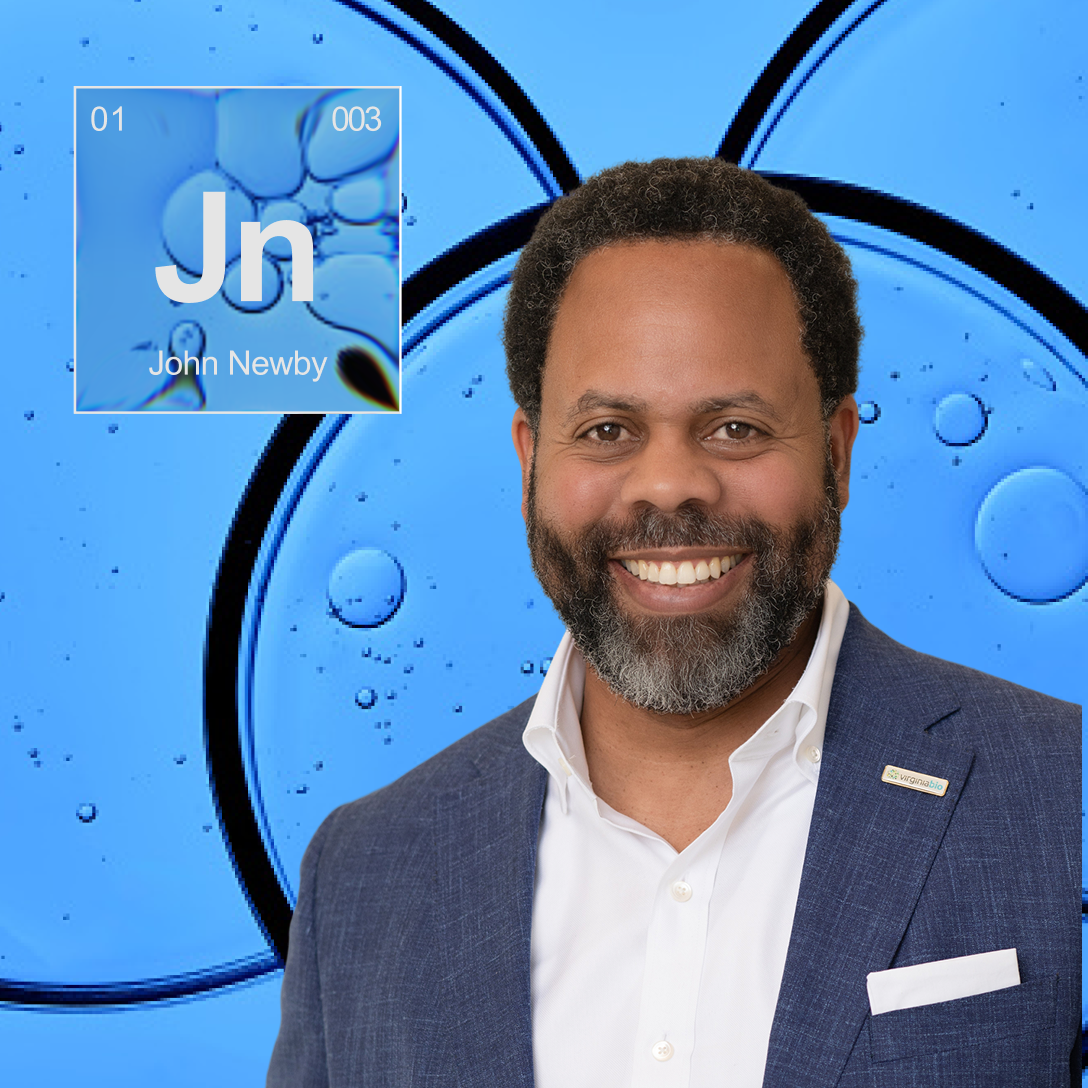
John Newby is the CEO of Virginia Bio, the nonprofit statewide trade association that serves and promotes the life sciences industry in Virginia. VEDP President and CEO Jason El Koubi spoke with Newby about recent major life sciences announcements in Virginia, the Commonwealth’s momentum in the biopharma manufacturing industry, and decisions and investments that led to Virginia’s biopharma success.
Jason El Koubi: We have had a lot going on in Virginia.
John Newby: In a good way, right?
El Koubi: In a great way. There’s so much happening in the life sciences. When I think about my 20-year career in economic development in different places, I have to say that last year is right up there with the most remarkable economic development stories in America right now. It’s a huge Virginia story. We had three major wins in advanced pharmaceutical manufacturing. You were a huge part of making Virginia ready for this kind of opportunity.
Newby: As you know, this was an overnight success that took 20 years.
El Koubi: Exactly. Like so many. Can you give us the background on Virginia Bio — the mission, activities, what you’re working on?
Newby: Virginia Bio is Virginia’s trade association for the life sciences industry. We have just north of 300 members, and 200 of those are companies.
Our member companies range from large strategic companies to startups straight out of the university taking technology and, hopefully, getting it to patients. Our mission is to cocoon that innovative spirit, to help those companies grow, and ultimately put solutions in the hands of patients and doctors.
One activity we engage in toward that goal is advocacy. We are the voice of the industry in Virginia. We advocate on the federal level with our congressional delegation in Washington, D.C., as well as the state level at the General Assembly and the governor’s office in Richmond. We also support our companies through memberships, supportive services, and education. How do you do this thing called life science entrepreneurship? How do you make partnerships? The third thing we do is connect our companies to capital, very important in this industry. Those three — advocacy, membership activities, and connecting to capital — are the main things we do to help the ecosystem.
El Koubi: It’s a huge ecosystem that has prepared Virginia for a moment. In 2025, we saw a lot of things converging. First, advances in technology that prepared new pharmaceuticals for market. They needed to be produced, so to produce them, you needed major expansions and new facilities. You also had a major shakeup in our trade environment, which put pressure on certain companies to produce more domestically in the United States. But you also had Virginia ready for that moment. As a result, we had three historic announcements in the latter part of 2025, any one of which individually would have made big news on its own.
Merck, AstraZeneca, and Lilly announced major new facilities or expansions in Virginia. Every project individually was more than $1 billion. Every one created hundreds of great jobs with all kinds of opportunities. Every one will generate a lot of spinoff and ripple through the ecosystem you just described. It was an incredible moment with all three projects announced within a few weeks of one another. By my math, it’s nearly 2,000 jobs. That’s a 60% increase in direct pharmaceutical manufacturing employment.
By almost any measure, this was truly historic. What in the economy is causing all this investment? What gave us the right to win?
Newby: I was joking that this is an overnight success that took 20 years. Actually, it’s more like 30-plus years. Virginia Bio was founded in 1992, at the same time as the Virginia Bio+Tech Park on the Virginia Commonwealth University campus. There wasn’t a whole bunch of biotech then, other than what was happening in Boston. Worldwide, in the ‘90s was internet tech, which eventually became a bubble. That was driving all the new money, growth, and wealth creation in America.
At the same time, we had these groups of founders for Virginia Bio say, “Look, that’s great, but we still know that at the end of the day, patients need solutions, and it will become even more important over time. We need to invest in biotech in Virginia to be at the leading edge of whatever that looks like 20, 30, 40 years down the road.” That was foundational because it put us on a long path to get to where we are now.
Over those 30-plus years since the founding, we’ve established a solid biotech ecosystem in Virginia. It started with Virginia Bio in Richmond, but today we have five regions — we call them BioHubs — each with their own ecosystem, company flavors, and focuses. They’re each very strong in and of themselves, but also connected to the statewide ecosystem.
I think the foundation of a strong ecosystem has allowed all these other successes — the three companies you mentioned and others — to look at Virginia and say, “These guys are connected, they’re moving forward, there’s a vision. Let’s go ahead and invest alongside them to get solutions to the hands of patients.”
El Koubi: About the moment we were in last year, why did so many major pharmaceutical companies make these big investments?
Newby: A big part of it was the political environment. The current administration has put focus on domestic production of all things we need in this country for our health. And it’s not just the administration. All of us saw in the COVID-19 pandemic our over-reliance on other countries for drugs and medicines. We needed to change that.
I think it was a confluence of timing — an administration that really focused on domestic drug production, a population who just came through a pandemic and saw the impact of drug shortages from being unable to get drugs from other countries, and companies realizing that for their own future, they needed to speed up their timelines of establishing more manufacturing in the United States. Many companies already had plans or were thinking about doing exactly what’s happening now. Everything has come together at a fortuitous time for Virginia.
We have great talent, which attracts companies like Lilly, Merck, and AstraZeneca, which attracts other companies to become part of the ecosystem, which thus attracts more talent because not only do the companies see there's something cool happening in Virginia, the talent also sees it.
John Newby, CEO, Virginia Bio
El Koubi: With that backdrop, it feels like an acceleration. In the last few years, we’ve had some major high-profile events putting Virginia on the map in this exciting sector. One thing that stood out was enormous announcements at the same time. The other big one was the Richmond-Petersburg region being selected, following rigorous national competition, as the recipient of more than $50 million in federal grant funding as part of the Build Back Better Regional Challenge. You saw different pieces of the ecosystem come together in the wake of the pandemic, saying, “Not only do we have this national challenge we need to rally around, but we’ve got the pieces we need to solve this problem in the core of Virginia.”
Take us through the last five years to the big announcements of these major facility investments last year. What’s the impact on the ecosystem? Now that you have historical growth in advanced pharmaceutical manufacturing, jobs and facilities will ramp up over the next three to five years. What does that mean for the rest of the ecosystem and where are we now?
Newby: The Build Back Better grant was fundamental to the growth you see across the state. But even before that was the great work done by Frank Gupton and VCU that led to creation of the Phlow Corporation. They got a substantial BARDA grant from the federal government for domestic production of essential medicines back in the early 2020s. That set in motion the concept behind the Build Back Better Grant application.
It’s continued today with formation of the Alliance for Building Better Medicine. I think that story has resonated not just with Virginians, but with companies like Lilly, Merck, and AstraZeneca, who have looked at this ecosystem building on the ground in Virginia. It lends itself to a positive future that these technologies are being homegrown, expanding in Virginia, and attracting more talent from other companies in advanced pharmaceutical manufacturing to Virginia.
At the end of the day, what does this all mean? After a successful grant like Build Back Better, after you have companies like Phlow and Civica Rx come to this ecosystem, now Novo Nordisk in that same space down in Petersburg, you have an ecosystem growing in development. I think that was part of the analysis of these three companies — an opportunity to get into an ecosystem allowing their domestic production of essential medicines in Virginia.
But that doesn’t just attract companies large, it also attracts companies small. Smaller companies wanting to innovate and find a landing place in this great country — “Where do I want to do it? Where things are growing and just kicking off the ground.” I think we have that advantage over other parts of the country with perhaps a longer, more established track record in life science, biotech, and advanced pharmaceutical manufacturing. You want to get in where it’s hot and new and be part of the wave going upwards.
The final thing that attracts all this great activity is talent. It’s a self-feeding loop. We have great talent, which attracts companies like Lilly, Merck, and AstraZeneca, which attracts other companies to become part of the ecosystem, which thus attracts more talent because not only do the companies see there’s something cool happening in Virginia, the talent also sees it. We want to get to the place where there are lots of options for this talent to come, live, thrive, grow, work, and have a career in life science and biotech without having to leave the state. I think we’re getting there now with the arrival of these three companies.
El Koubi: This great innovation corridor is emerging. Everybody knows about the tremendous innovation in Northern Virginia and the D.C. metro area, but this innovation corridor in pharma includes the area you were just describing — the Richmond-Petersburg region, this Build Back Better Regional Challenge grant and all the infrastructure with that, and the amazing story of the Alliance for Building Better Medicine.
Lilly is investing directly in this region, but then west down Interstate 64 past the Lilly facility is Charlottesville and that amazing region, with the University of Virginia and the Manning Institute, another incredible life sciences research facility. That’s where AstraZeneca is putting two facilities, one of them its largest in the world. And then you go to the other side of the beautiful Blue Ridge Mountains to Merck’s facility in the Shenandoah Valley. And if you keep going down I-81, you’re in the city of Roanoke, with a leading medical school, leading life science research.
I look at it from the perspective of startups and companies that have been here and continue to grow. I want to ask them, “Why have you stuck around? Why do you continue to invest in Virginia?” It’s because Virginia gives back to them.
John Newby, CEO, Virginia Bio
It’s a nice string of life sciences pearls in this incredibly special corridor, which is also full of wonderful places to live. Every place says it has a high quality of life, but I think in Virginia you see the marriage of innovation and quality of life in a way that attracts companies and the people who fuel some of the world’s leading-edge technologies.
Newby: I’m as excited as you are. You paint a great picture of not just geographic diversity, but ecosystem diversity within the life sciences and biotech. I’d like to start a little bit farther to the east, including our friends in Hampton Roads, who are excited about the new merger of Eastern Virginia Medical School and Old Dominion University and what comes with that partnership, and also the companies in that area.
LifeNet Health is one of the world’s largest companies facilitating organ transplant in the world, and it’s happening in Virginia Beach. From what we call the Coastal Virginia BioHub with those activities, coming west toward Richmond, north toward Northern Virginia, Charlottesville, and then west to Roanoke and Blacksburg. It presents a nice option for folks looking for a career and quality of life, and great opportunities for companies to come and tap into that talent pool. We’ve got it all.
El Koubi: It reminds me of conversations I had with site selection leaders about their processes as Merck, AstraZeneca, and Eli Lilly were all about to choose Virginia at the same time. I said, “We’re thrilled that you’re coming to Virginia. By the way, one of your competitors is also coming. What’s your reaction to that?”
What I heard is that they didn’t want to be on top of one another in the same area, but were thrilled that other companies they respect and benchmark against were also choosing this ecosystem. It’s a place where if you choose a career at one of these facilities, you’ve got a lot of options. You can climb the ladder within a company, but as we say at VEDP to our own talented employees, it’s a rock wall. You don’t just have to go up all the time. You can go over and do different things in this amazing sector. You have the same options in life sciences.
Newby: For years, that wasn’t necessarily what was happening in Virginia, this opportunity to move and stay within the borders. Most folks would point to, say, the Bostons of the world, the San Franciscos, and other places where you can leave one job on Friday and literally walk across the street and have a new, strong, equivalent job on Monday.
In Virginia with these new companies, we’ll have that across-the-street opportunity from one top-quality company to the next. Even more importantly, this ecosystem is great for our universities, which are already putting out a great talent pool. Now we can point these young men and women to opportunities that keep their talents and families in Virginia more now than ever.
El Koubi: We’ve already touched on some reasons why companies like Lilly, AstraZeneca, and Merck are growing in Virginia, along with hundreds of other members of Virginia Bio. What are some other key reasons? What are key things you say about the value proposition, why grow in the life sciences in Virginia?
Newby: I look at it from the perspective of startups and companies that have been here and continue to grow. I want to ask them, “Why have you stuck around? Why do you continue to invest in Virginia?” It’s because Virginia gives back to them. I know many of our companies and startups, small companies, have other opportunities to move, especially when they can get investment from venture capitalists and others. They’re probably always asked if Virginia is the right spot.
We need to continue supporting startups as they grow so that their technologies can be put in the hands of patients. I think as long as Virginia stays business-friendly, writ large, and continues the past five years’ focus and investment in biotech, the entire ecosystem, and ultimately patients in Virginia and around the world, will benefit.
John Newby, CEO, Virginia Bio
Many stay because of things we’ve already mentioned — the talent pool, the fact that they came up in this environment, that Virginia is investing in them in more ways than one. Many of them have received direct investments from, for instance, the Virginia Innovation Partnership Corporation and their programming. They perhaps have also gotten funding from the Catalyst program, which incentivizes companies and universities to work together to commercialize technologies.
Small and medium companies stay in Virginia for myriad reasons, and we need to stay in front of that. I think we can leverage the presence of larger companies to continue supporting small and medium companies by building networking relationships, research opportunities, and partnership opportunities with the larger companies as further incentives to stay and see what that could bring to them.
El Koubi: You talked about the ecosystem, including some startups, innovative companies that are this sector’s future. Here at VEDP, when we are engaged with a company looking to make a big business investment decision, we typically emphasize five things — not just to life sciences companies, but across all sectors. One I’ve touched on, and that’s innovation and quality of life. You’re going to be among amazing businesses leading in their sectors and benefit from being surrounded by innovation in the same way our incredible quality of life attracts and retains people.
Another huge selling point for Virginia is we’re one of few places in America where you can have it all. Our business climate ranking, CNBC, for example, always has Virginia toward the top of the list. We’ve been No. 1 more than anybody else. A big reason is Virginia performs well above average in every category measured, frequently in the top 10. We also have extraordinary talent advantages. We’re attracting people. We’ve got great alignment between our colleges and universities and the needs of businesses and the economy. And we also have great solutions for individual companies. In fact, we’ve got the number-one-ranked talent solution through the Virginia Talent Accelerator Program.
We have great infrastructure, connecting companies and people to the rest of the world, airports that can take you directly to 200 different places. We have amazing data infrastructure and great sites ready and investible. Finally, we have partnerships that quickly solve all kinds of business problems. One thing we heard from companies was how impressed they were by Virginia’s speed at proposing solutions. You talked about overseas companies considering Virginia. VEDP’s foreign direct investment team set up the first meeting with AstraZeneca and 33 days later, after two site visits, that project was announced.
Newby: That’s unheard of.
El Koubi: Those elements combined are an incredible formula for success.
Newby: I was thinking about why companies choose our ecosystem to invest in versus other biotech ecosystems. It’s the lower barrier to entry. For all five of those areas you mentioned, companies can access people and resources to take advantage of those things. It’s the business climate, the political climate, the policy climate. The willingness of Virginia to invest. There’s a low barrier to entry to get to know our ecosystem. Not all ecosystems are as open and easy to navigate.
El Koubi: Is there anything else about Virginia or about Virginia’s life sciences ecosystem that you find surprises people?
Newby: I have a couple of nice examples to give people when they say, “Tell me something I don’t know about biotech in Virginia.” I always start by asking “When you opened your medicine cabinet this morning, what did you see? Did you see Sensodyne toothpaste? Advil? FLONASE? TUMS?” They’re consumer products and guess what? They’re all from a company right here in Richmond by the name of Haleon — formerly GSK, formerly Pfizer.
All of these consumer products are researched and improved in Richmond. This company has been in Richmond since the 1960s, recently having a growth spurt in the past couple years adding hundreds more scientists. But companies like Haleon in Virginia are doing really special things in the consumer products division.
Another great example of something that people may not know about Virginia’s biotech industry — back in 2022, the first transplant of a pig heart into a human. Thousands of Americans a year unfortunately die for lack of an available organ for transplantation. A company in Blacksburg by the name of Revivicor, which has since been acquired, genetically modified a pig to transfer its heart into a human being for the first time and it was successful. R&D is continuing to extend the lifespan of persons with these transplants to get better and better over time. In the meantime, they also had the first human transplant of a pig kidney into a human in 2024. All these advances to extend life are happening in Virginia.
Those are two cool things I like to point out that people may not know. It shows the diversity of biotech and how it can impact lives. Always something from as simple as the FLONASE I took this morning to avoid springtime allergies, all the way to organ transplantation from an animal into a human to extend that human’s life. We’re doing it all in Virginia.
El Koubi: Every time we sit down, I learn something new and amazing from you. What are we doing to keep all this going? I know a little bit from my angle at VEDP, but what are some things you’re doing and some things we need to do to build on this momentum?
Newby: What’s going to determine our future success doesn’t necessarily lie in big companies. It starts with small companies. Startups are the big companies’ feed stock. We have that ecosystem on the ground, the small companies, in Virginia right now.
We need to continue supporting startups as they grow so that their technologies can be put in the hands of patients. I think as long as Virginia stays business-friendly, writ large, and continues the past five years’ focus and investment in biotech, the entire ecosystem, and ultimately patients in Virginia and around the world, will benefit.
El Koubi: John, always good to get together with you.
Newby: I really appreciate it. Thanks for the time.