
Continuous Improvement

A pharmaceutical manufacturing innovation that came out of a Virginia university is changing the way medicines are made. The Commonwealth’s universities and the rest of its biopharma research community are making sure Virginia is ready to make the medicines of the future.
Continuous manufacturing, researched and developed at Virginia Commonwealth University’s (VCU) Medicines for All Institute, is enabling manufacturers to increase their production of key pharmaceutical ingredients and strengthen the pharma supply chain. Virginia has worked tirelessly to ensure a workforce that matches up with its research strengths. Now, the Commonwealth is in position to develop future medicines and deploy innovative techniques that enable their creation.
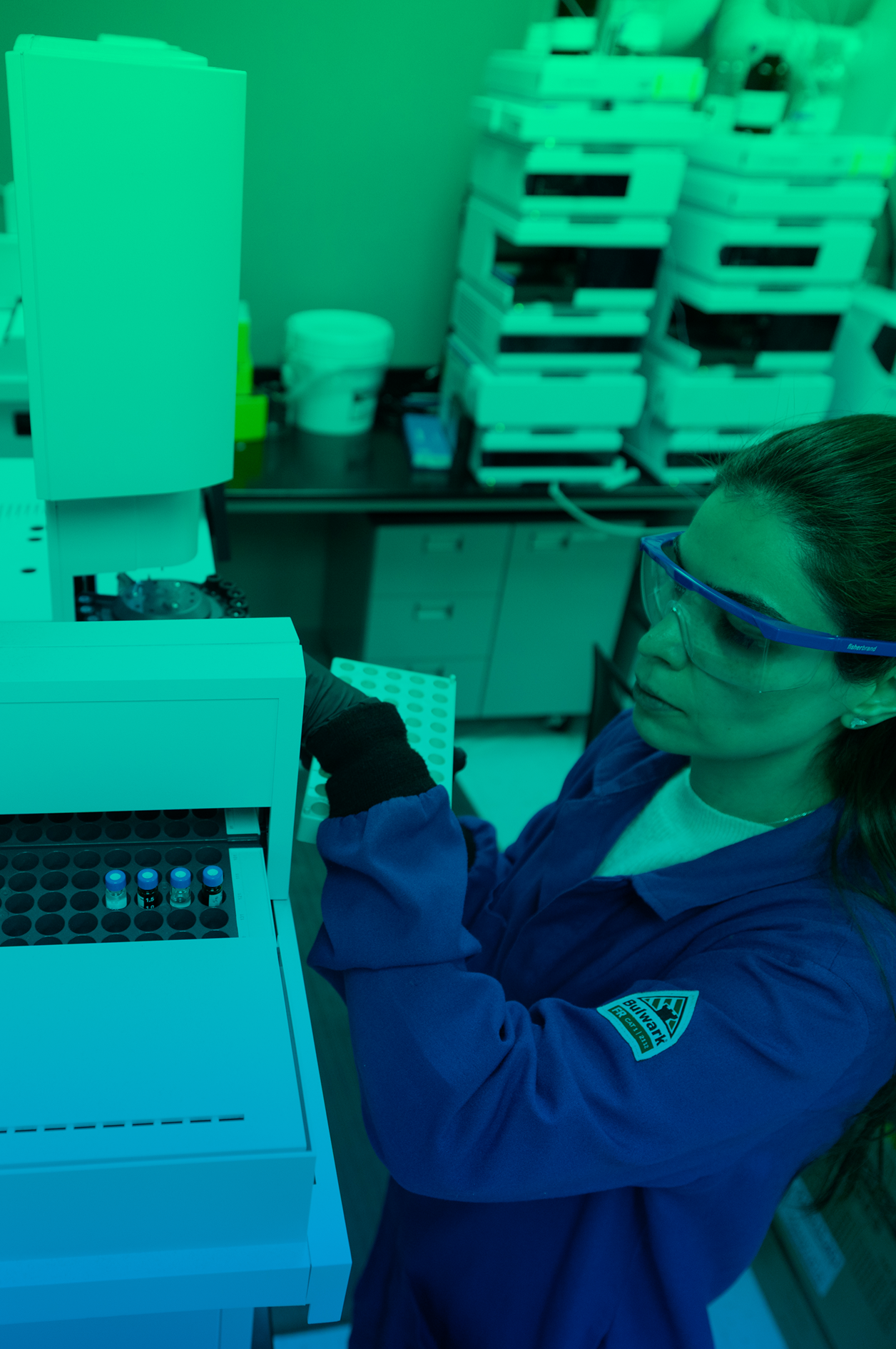
MANUFACTURING INNOVATION AT VCU
Broadly speaking, there are two major ways to make finished medicines and their active pharmaceutical ingredients (API). You can think of them like the ingredients in a plate of spaghetti, according to Dr. Frank Gupton, chair of the Medicines for All Institute (M4ALL) at VCU’s College of Engineering.
Traditionally, drugs have been manufactured by hand in relatively small batches, like homemade pasta sauce. Beyond natural variation and human error, older generic medicines rely on techniques and chemical reactions that haven’t been revisited in decades. These processes can be labor-intensive, leading to production migrating overseas.
On the other hand, industrial dried noodles are remarkably consistent, extruded from a machine that can continuously produce pasta so long as the ingredients are provided. As experts revisit processes in search of ways to make higher-quality, more reliable medicines, rethinking drug manufacturing to be more like pasta-making is one major avenue of improvement.
Critically, production methods can often be reengineered to meaningfully trim expenses, enabling reshoring of pharmaceutical manufacturing to the United States and Virginia in particular. Good reasons are plentiful for increasing American pharmaceutical manufacturing capacity, but it’s largely possible thanks to careful chemistry and innovative engineering.
“Redesigning how a drug is made, not just where it’s made, leads to better quality, lower costs, and a much more resilient supply chain,” said Robby Demeria, chief corporate affairs officer at Phlow Corp., a Richmond-based public benefit corporation that spun out of the Medicines for All Institute and develops and refines drug manufacturing processes by combining expertise on both the academic and commercial sides.
Eli Lilly Chair and CEO David Ricks echoed those thoughts in announcing his company’s $5 billion manufacturing facility in Goochland County, near Richmond: “By expanding our domestic capacity, we’re building a secure, resilient supply chain that delivers for patients today and supports the breakthrough medicines of tomorrow.”
VIRGINIA MEETS THE BIOPHARMA MOMENT
Since 2020, Phlow has been an important part of a pharmaceutical hub in the cities of Richmond and Petersburg that has formed around the Medicines for All Institute at VCU’s College of Engineering. Civica Rx, a nonprofit focused on drug shortages and improving access to essential medicines, is another key member, with facilities in Petersburg and Chesterfield, just south of Richmond. Elements for growth are in place, including a knowledgeable core, well-established cross-sector pharmaceutical cooperation, and the foundation for a next-generation workforce pipeline.
Over the past decade, collaborative efforts have attracted millions in private investment and federal grants to Virginia. For example, work by the Alliance for Building Better Medicine led to a tech hub designation and a Build Back Better grant through the U.S. Economic Development Agency. And now, among other factors, the influence of the hub, with its focus on innovative pharmaceutical production, has helped draw further pharmaceutical business to Virginia with impressive financial commitments attached.
In fall 2025, three major pharmaceutical companies announced further investments in the Commonwealth totaling billions of dollars and thousands of new jobs. In addition to the aforementioned Eli Lilly facility in Goochland County, AstraZeneca escalated existing plans to invest $4.5 billion in manufacturing in Albemarle County, and Merck has broken ground on a $3 billion site near its existing plant in Rockingham County.
“We’ve chosen to build this new state-of-the-art manufacturing facility in Virginia because of its strong skill base and capabilities in life science, as well as in advanced manufacturing,” said Pam Cheng, executive vice president of global operations and IT and chief sustainability officer at AstraZeneca.
Medicines for All Institute, Virginia Commonwealth University
A FUTURE-PROOFED WORKFORCE
Crucially, each facility will be located near a major Virginia university — VCU near Eli Lilly, the University of Virginia (UVA) near AstraZeneca, and James Madison University near Merck — providing a ready-made pipeline of skilled workers. While the new facilities will capitalize on the workforce coming out of those universities, community colleges, and other educational partners, and new initiatives like the recently announced Virginia Center for Advanced Pharmaceutical Manufacturing (VCAPM), legacy Virginia pharma manufacturers have been drawing their workforce from Virginia universities for decades.
“As our major departments formed, it turned out that the engineering department was uniquely staffed with Virginia Tech graduates, quality assurance was UVA graduates, and microbiology was James Madison graduates,” said Thomas Thorpe, CEO at contract manufacturer Afton Scientific, which has operated in Albemarle County since its founding in 2000. “It makes things fun during football season.”
As pharma manufacturing shifts, those universities have shifted with it, with the focus on automation and artificial intelligence (AI) driving the future of the industry. UVA and Virginia Tech particularly have generated significant patent activity in pharmaceutical and medicine manufacturing, producing a combined 156 patents since 2020, according to Google Patents data. Additionally, UVA is incorporating AI into numerous program disciplines.
“We have some great programs at UVA, both in engineering and in data science, that are really at the cutting edge of what many people are putting into their plants,” said Blair Okita, a professor of practice at UVA’s School of Engineering and Applied Sciences and a 35-year veteran of the pharmaceutical manufacturing industry. “Those have been areas of research for quite a while.”
VCAPM was founded with the help of $12.5 billion in capital investment, including $120 million in contributions from AstraZeneca, Eli Lilly, and Merck. At full capacity, the center will produce more than 2,000 pharmaceutical manufacturing professionals each year.
“We can take existing skill sets we’ve got here to build a workforce pipeline that not just meets current needs for pharma, but is looking forward to what future skill sets will be needed to achieve long-term objectives,” Gupton said.
A state government that was ready to communicate and collaborate in development also helped in decision-making, at least for AstraZeneca. “The Commonwealth of Virginia really surprised us on how fast the government can move, [and] that sense of urgency to do everything you guys have, to build a better future for the local community, and in this case, for American people with innovative medicine,” Cheng said.
We can take existing skill sets we’ve got here to build a workforce pipeline that not just meets current needs for pharma, but is looking forward to what future skill sets will be needed to achieve long-term objectives.
Dr. Frank Gupton, Chair, Medicines for All Institute
IMPROVEMENTS THROUGH PROCESS ANALYSIS
Gains in efficiency are to be found across multiple pharmaceutical manufacturing processes, and not every improved manufacturing step will be continuous. For example, Phlow recently announced that it has devised a better way of batch-producing epinephrine, the medical form of adrenaline that has multiple uses, notably as a lifesaving response to severe allergic reactions. In the United States, epinephrine has been considered in shortage for over a decade, and every phase of Phlow’s new process can be completed domestically.
Traditional batch processes — with legacy inefficiencies and costs, including labor — do not generally translate well to U.S. manufacturing. That’s why, for federal-level policymakers, rethinking how important pharmaceuticals are manufactured has been critical to the cause of a secure supply of American-made essential medicines and their precursors. The COVID-19 pandemic exposed the fragility of pharmaceutical supply chains, and avoiding future drug shortages in the United States in critical situations may require the ability to manufacture finished medicines and their components within the country.
“We believe in a global supply chain, but need to have the capabilities and resilience here in the U.S. should there be — or when there is — a pandemic, a geopolitical crisis, or a natural disaster,” Demeria said.
Treating pharmaceutical manufacturing as strategic infrastructure in addition to important business has helped the industry grow in Virginia with bipartisan support across presidential and gubernatorial administrations. Phlow is involved with the creation of a national Strategic Active Pharmaceutical Ingredient Reserve (SAPIR) that will help ensure a steady supply of essential medicines in emergency situations. A 2025 executive order from President Donald Trump mandated that SAPIR create a six-month stockpile of API necessary to manufacture those medicines.
CREATING BETTER, SAFER MEDICINES
Labor cost is often the focus in discussions of how to bring manufacturing back to the United States from China or India. While new pharmaceutical engineering can cut costs, Gupton also notes the advantage of high repeatability, infrequent failed chemical reactions, and the potential to use ingredients and produce byproducts considered better for the environment. In some cases, the medicines can even be safer for patients.
For example, around 2020, scientists discovered that doses of rifapentine, an antibiotic used to treat tuberculosis, contained concerning levels of carcinogens because of the way it was produced. The drug stopped production, but left a gap in tuberculosis treatment, making the disease especially deadly for people with weakened immune systems. But VCU researchers have developed a carcinogen-free continuous manufacturing process for rifapentine that is hoped to reintroduce treatment options and save many lives around the world.
This creative pharmaceutical engineering is only possible with the right mixture of expertise in a variety of fields. “One of the things we’ve found is that innovation [lies at] the interface of different disciplines,” Gupton said. “I think it’s going to require us to think differently about how we educate students at colleges and universities.”
Chemistry and chemical engineering may be at the heart of new processes, but beyond science, engineering, and core chemistry, pharmaceutical industry growth in Virginia has required significant contributions from educators, government, and private businesses, and close communication among all parties.
Virginians have found ways to work with national strategic visions and support business with state-level programs. Institutions continue to develop ways to support a growing pharmaceutical workforce, including novel ways to produce APIs and finished medicines, and the skilled labor ready to implement those new practices and processes. Billions are being invested in the infrastructure needed to ramp up the Commonwealth’s manufacturing.
By reengineering their production methods and incorporating emerging technologies, Virginians are creating more reliable, higher-quality medicines in greater quantities within the United States. Whether those drugs have domestic strategic value or will be sold in every corner of the world, reimagining the chemistry means rethinking the ability to improve quality of life, extend lifespans, and save lives.